The Party Is Also a Map: Kenya’s 2027 Contest for Citizen Power
Part V of The Map Is Also a Ballot
Evidence reviewed as of 25 September 2026. Party registration claims are attributed to reporting and party statements; ORPP listings should be rechecked for later changes. Planned unveilings and reported negotiations are not treated as completed events.
On this page
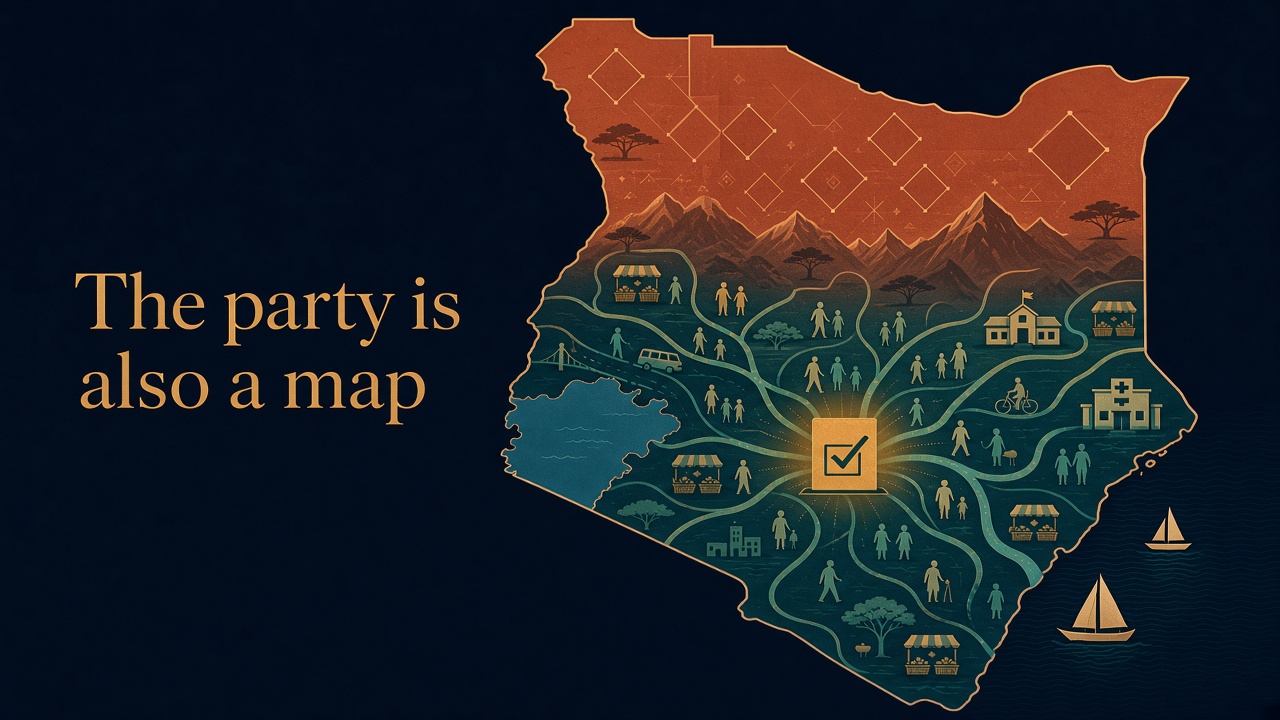
A constituency draws a boundary around representation. A candidate gives a public face to a political promise. A party helps determine who may carry that promise onto the ballot.
This commentary extends the organising question of The Map Is Also a Ballot to Kenya’s 2027 electioneering: how do the structures of politics shape the power citizens can exercise?
Part I examined constituency boundaries and incentives. Part II asked whether a candidate’s political moment could become a civic movement. Part III tested crowdsourcing and crowdfunding against the harder work of building citizen-governed institutions. Part IV turned to convivial democracy: the shared systems through which people already live together.
This fifth instalment brings that argument to party rules, nominations and coalition agreements across Kenya’s political divide. The companion essay Tribal Numbers: Count Us, Then Account to Us adds an evidentiary warning: counting people does not confer ownership of their choices.
The party is also a map. Its boundaries are drawn through decisions about belonging, leadership and access to the ballot. Coalition zoning does not redraw legal constituency lines; it rearranges organisational power. Geographic representation, organisational control and shared civic systems remain distinct.
Geographic map
Legal constituency boundaries, where citizens are registered to vote.
Organisational map
Parties, nominations and coalition bargains, who may carry a promise onto the ballot.
Civic systems map
Shared life, markets, transport, care and learning, where interdependence already exists.
Two Arenas of Electioneering
Kenya’s election is taking shape in two arenas.
One is public: rallies, development tours, market visits, speeches and social media. The other concerns the organisations through which power will be contested, party leadership, nominations, coalition agreements and decisions about who stands where.
The public arena
- Rallies, tours, speeches and social media
- Shows who attracts attention
- Does not decide who reaches the ballot
The organisational arena
- Leadership, nominations and coalition bargains
- Shapes who may stand, and where
- Tests whether members still hold influence
To understand electioneering across the political divide, we must examine both. The crowd tells us who attracts attention. The organisation helps determine who gets onto the ballot and whose interests survive a political bargain.

The emerging picture combines consolidation, fragmentation and negotiation. Guerrilla tactics offer a partial metaphor for the contest over attention; they cannot explain the entire electoral landscape. That distinction applies to government-aligned formations, opposition parties, emerging movements and independent contenders alike.
Consolidation on the Governing Side
Start with the governing side. UDA’s January 2026 NEC statement authorised structured engagement with ODM towards a coalition. [1] In August, President William Ruto announced a joint manifesto process and the intention to contest the 2027 election together. The Star reported the formation of a ten-member manifesto team. [2] These are documented steps towards electoral cooperation, rather than proof that every outstanding coalition question has been settled.
My reading is that this approach seeks to turn cooperation in government into a wider electoral alliance. Its potential strength is a common programme supported by several organisations. Its vulnerability is the negotiation required to accommodate their competing ambitions.
September reporting by Nation described disagreements over electoral zoning, arrangements concerning which partner would contest particular areas. [3] The same organisations can cooperate over the presidency while competing over parliamentary and county positions.
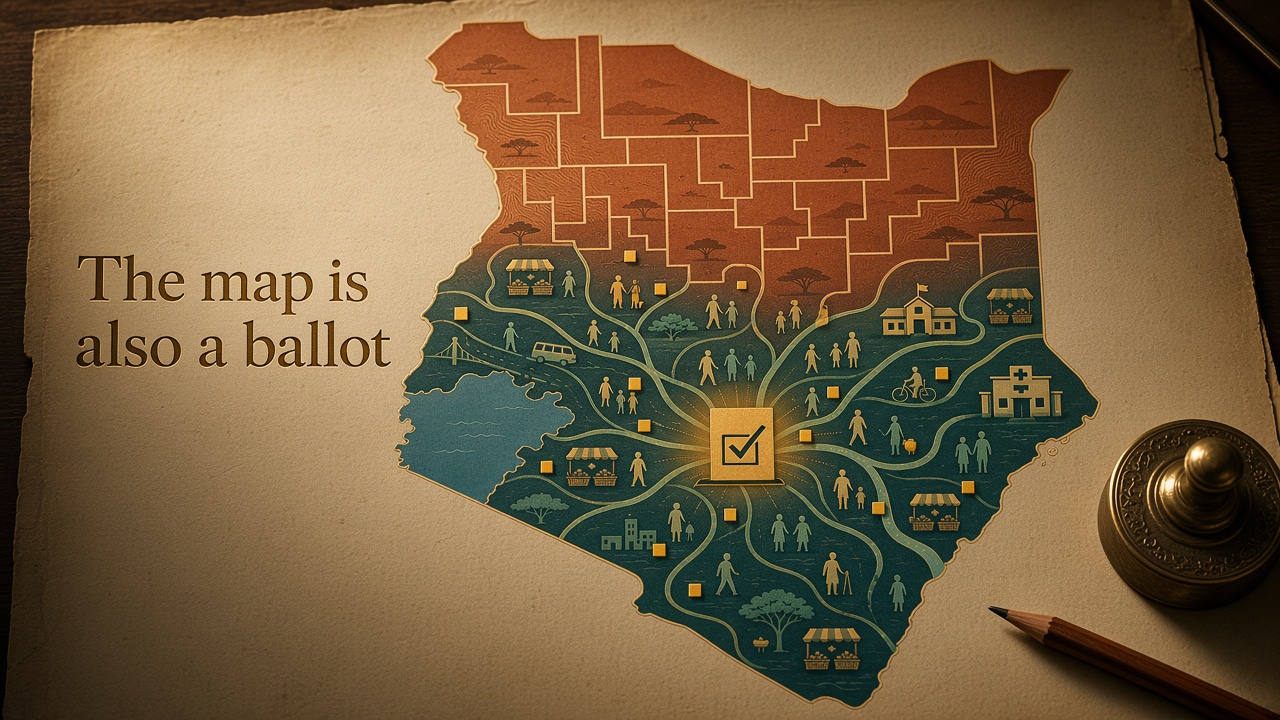
A handshake at the top does not eliminate competition below it.
Opposition Autonomy and Party Proliferation
The opposition faces a related problem from a different starting point. Leaders seeking to replace an administration must also agree on how to work together, how to choose candidates and how much independence each organisation retains. This helps explain why party proliferation and calls for unity can occur simultaneously.
Recent developments include Gachagua’s Democratic Congress Party (DCP), Amisi’s People’s Renaissance Movement and Khalwale’s association with the United Patriotic Movement (UPM). Owalo launched the People’s Prosperity Party (PPP), reported by Nation on 20 September as provisionally registered. Nyoro announced his move to the People’s Party of Kenya (PPK) in August. Karua’s People’s Liberation Party (PLP) emerged through the rebranding of NARC-Kenya. These developments differ: forming, joining and renaming parties should not be counted as the same act. [4] [5] [6] [7]
Linda Mwananchi contains the same tension. Babu Owino has described securing a party because he doubted ODM would support his Nairobi gubernatorial ambition. [8] Separately, Natembeya announced a planned UDP route for Sifuna, with an unveiling expected in early October. The proposed arrangement remained prospective at this commentary’s evidence date. [9]
Taken together, these cases support an interpretation centred on political autonomy: leaders want room to cooperate without leaving their electoral futures entirely in another organisation’s hands. That can protect legitimate representation. It can also protect personal control. We should examine each party’s conduct before deciding which explanation fits.
Seen through the series’ lens, proliferation can redraw the organisational map without changing the distribution of voice within it. A new party may open an excluded candidate’s route to office while leaving ordinary members with little influence. Conversely, separate organisations can protect legitimate differences within a wider alliance. The test is how authority works, not how many flags appear.
Many flags
- New parties, renames and switches
- Can open a candidate’s route to office
- Does not prove members hold authority
Distributed voice
- Influence over leadership and nominations
- Scrutiny of money and coalition terms
- Dissent that can survive without exclusion
Alternative explanations, nomination protection, bargaining leverage, policy disagreement, mistrust and personal ambition, remain interpretations unless an actor has stated a motive explicitly. Political analysis becomes unreliable when every disagreement is described as a clever tactic.
The Guerrilla Metaphor, and Its Limits
Mobile rallies, rapid messaging and dispersed participation can resemble an asymmetric contest over attention. Yet the existence of several parties does not prove coordinated manoeuvres under one command. Some developments may reflect planning; others may reflect mistrust, organisational weakness or unresolved ambition. Guerrilla imagery may illuminate campaign mobility. It does not establish armed activity, covert coordination, decentralised command or a deliberate military doctrine.
What mobility can show
- Rapid messaging and dispersed participation
- Asymmetric contests over public attention
- Useful as a limited campaign metaphor
What it does not prove
- Armed activity or military doctrine
- Covert coordination under one command
- That every disagreement is a clever tactic
Neither camp can assume that a leader’s endorsement automatically transfers supporters. This extends the distinction in Tribal Numbers: population, registration, participation and political choice require different evidence. A shared opponent does not establish a shared governing programme. Equally, cooperation in government does not establish public agreement with that cooperation.
Incumbency, Challenge and Evidence
Serving leaders have a record to defend and the visibility that accompanies official responsibilities. Challengers can scrutinise that record and propose alternatives. These are different positions, requiring different evidence.
The EastAfrican’s September reporting described presidential development engagements alongside opposition tours in Nairobi and Northern Kenya. [10] The public contest thus extends across project sites, meeting grounds and everyday community spaces. A launch or inspection is an event; sustained service is an outcome. Publicly funded development belongs to the public, and its value should be assessed independently of partisan credit, without assuming that every development visit constitutes misuse of public resources.
For a challenger, the questions concern feasibility: what would change, what would it cost, how would it be financed and which trade-offs would follow? Criticism can identify failure without demonstrating the capacity to remedy it. Opposition status does not itself establish competence.
The governing side must substantiate performance. The opposition must substantiate its alternative. Both must answer for their conduct.
Incumbency must show
- What was promised, funded and delivered
- Who benefits, and at what cost
- Event versus sustained service
Challenge must show
- What would change, and how it is financed
- Which trade-offs follow
- Criticism is not the same as capacity
The same discipline applies to political numbers. A rally is evidence of attendance. A party sign-up records participation in that process. A donation records a contribution. None independently establishes how someone will vote.
01
A rally
Evidence of attendance on a day, not of how someone will vote.
02
A party sign-up
Records participation in that process; membership is not a mandate.
03
A donation
Records a contribution. Money and loyalty are not the same claim.
04
A vote
The only measure that settles a contest, and it is not additive from yesterday’s crowds.
TIFA’s June 2026 national survey found that 28 per cent of respondents did not identify with a political party. The study interviewed 2,048 adults across all 47 counties between 13 and 22 June, with a reported overall margin of error of ±2.18 percentage points. It is a dated snapshot, not a September forecast, but it illustrates why leaders should not be treated as owners of the electorate. [11]
Coalition arithmetic cannot simply add yesterday’s party support and assume tomorrow’s votes.
Citizen Power Beyond the Handshake
Nor is the General Election only a presidential contest. Alliances have consequences for the choices available in parliamentary and county races. An arrangement celebrated as national unity may be experienced locally as exclusion if members believe decisions have been made without them. Independent candidates and issue-based civic participation remain part of that landscape.
This is the coalition map: an arrangement over political competition, distinct from the legal map of constituencies. Its democratic value depends in part on whether members can influence the bargain and whether citizens retain meaningful choices. Cooperation over shared problems must be assessed separately from the distribution of positions among leaders.
Research on Kenyan campaign finance published by Brookings in March 2026 describes how personalised party leadership influences candidate recruitment, resources and strategic direction. [12] It gives us a reason to look beyond the number of party flags and examine the distribution of authority within each organisation.
More parties can widen choice. Mergers can simplify it. Coalitions can assemble a workable governing majority. None of these structures guarantees internal democracy or accountable government. The useful tests are concrete: can members influence leadership and nominations? Can they scrutinise money? Are coalition commitments explained? Can dissent survive without exclusion? Are policy promises measurable?
01
Leadership
Can members influence who leads?
02
Nominations
Can they shape who stands where?
03
Money
Can they scrutinise financing?
04
Coalitions
Are bargains explained and enforceable?
05
Dissent
Can disagreement survive without exclusion?
06
Promises
Are policy commitments measurable?
These questions belong at the centre of electioneering across the divide. They also leave room for voters who reject the available camps, support independent candidates or organise around issues without accepting a party identity. The citizen is more than a headcount at a rally or an assumed share of a coalition.
Kenya’s 2027 contest will determine who occupies public office. The organising and bargaining happening now will also shape how those officeholders reach power, and to whom they feel accountable.
When leaders announce that they have united, the citizen is entitled to ask: around which public commitments, decided by whom, and enforceable how?

Sources and Evidence Note
Sources checked against reporting and primary statements available as of 25 September 2026. URLs below are working links used for attribution; some news URLs may redirect if publishers revise paths. ORPP registration status should be rechecked independently for later changes.
- [1] UDA NEC statement, 14 January 2026, party statement used as evidence of announced decisions. See UDA. (accessed 25 September 2026)
- [2] The Star, “Kenya Kwanza, ODM form 10-member team to draft joint 2027 manifesto”, 10 August 2026. (accessed 25 September 2026)
- [3] Nation, “Ruto, Oburu pact faces first major test over 2027 zoning plan”, 13 September 2026. (accessed 25 September 2026)
- [4] Nation, “Scramble to own parties: The fight for power, money and influence”, 20 September 2026. Registration context cross-checked against ORPP materials. (accessed 25 September 2026)
- [5] Office of the Registrar of Political Parties, orpp.or.ke. (accessed 25 September 2026)
- [6] Citizen Digital, “Ndindi Nyoro dumps UDA, joins opposition ahead of 2027 elections”, 17 August 2026. (accessed 25 September 2026)
- [7] PLP, Karua’s Narc Kenya rebrand to People’s Liberation Party, announced February 2025. (accessed 25 September 2026)
- [8] Citizen Digital, “Babu Owino reaffirms support for Sifuna’s presidential bid, reveals he has own political party”, 15 September 2026. (accessed 25 September 2026)
- [9] Citizen Digital, “Sifuna to be unveiled as UDP presidential aspirant in October, Natembeya”, 24 September 2026. Prospective at evidence cutoff. (accessed 25 September 2026)
- [10] The EastAfrican, “Ruto moves to ringfence his turf as opposition tests its mettle in Nairobi”, 12 September 2026. (accessed 25 September 2026)
- [11] TIFA Research: “Kenya’s Road to 2027 General Election: Political parties, presidential contest and coalition dynamics,” published 26 July 2026. Fieldwork: 13-22 June 2026; 2,048 adults; reported overall margin of error ±2.18 percentage points. See tifaresearch.com. (accessed 25 September 2026)
- [12] Brookings, “Building resilient democracies: Campaign finance issues and reforms in Kenya”, March 2026. (accessed 25 September 2026)
From reading to civic action
Party rules and coalition bargains shape who reaches the ballot. Follow public commitments whose delivery can be checked, then learn the practice of shared civic work.
Improve this article
Ask a question, suggest a correction, submit a source, share experience, or propose a topic. Contact details stay private. Publicly consequential allegations need editorial review.