From Ethnic Geography to Convivial Democracy
Paul Gilroy, Kenya’s Constituencies and the Politics of Shared Life
On this page
- A Matatu Full of Kenya
- Paul Gilroy and the Ordinary Practice of Living Together
- Everyday Kenya Is Already Convivial
- Geography Does Not Create Tribe, But Politics Can Freeze It
- Electoral Systems Make Some Identities More Valuable
- The Convivial Constituency
- From Sameness to Interdependence
- The Boda Boda Constituency
- The Food-System Constituency
- Think of Gikomba
- Conviviality Is Not a Fairy Tale
- From Anti-Tribalism to Institutional Design
- An African Relational Reading
- Sifuna and the Convivial City
- Living Constituency Commons as Civic Laboratories
- Three Models of Representation
- County, Senate and National Assembly
- What If Kenya Were the Constituency?
- The Map Can Disappear and the Tribe Can Survive
- International Lessons
- Constitutional Reality
- From Ethnic Geography to Convivial Democracy
- Sources and Further Reading
Conceptual illustration, not an official or proposed IEBC boundary map. Lower half: diverse citizens share a city street and transport corridor under rigid electoral grid lines. Upper half: those boundary lines dissolve into relational pathways connecting systems of everyday interdependence. Central idea: political representation beginning from the systems through which Kenyans already live together.
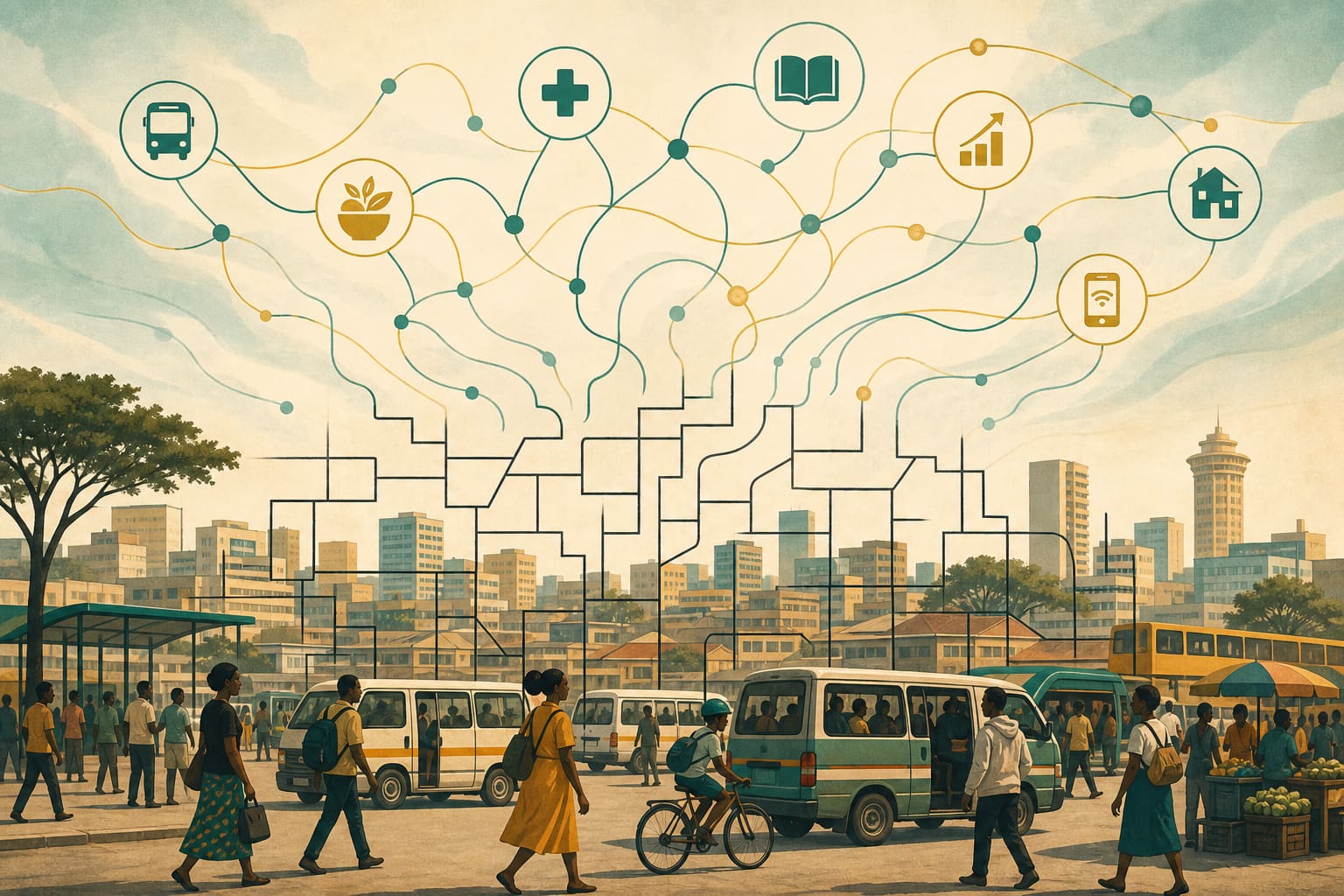
Perhaps Kenya’s democratic problem is not simply that we have failed to transcend our differences. Perhaps our electoral architecture repeatedly asks us to forget how much of our everyday life already transcends them.
In The Map Is Also a Ballot, I argued that constituency boundaries are not neutral containers: they shape who politicians must persuade and which identities become electorally profitable. In The Candidate Is Also a Map, the question turned toward civic movements and whether a national candidate can pass local tests built around shared problems rather than ethnic brokerage. This essay continues that journey, but shifts the argument from electoral geography toward what I will call convivial democracy.
The claim is not that Paul Gilroy wrote about Kenyan constituencies. He did not. This is an application of his social theory of convivial culture to Kenya’s electoral architecture, a new interpretation, offered carefully, and distinguished from both constitutional fact and speculative redesign.
A Matatu Full of Kenya
Consider an ordinary Nairobi matatu on an ordinary morning.
The passengers may identify as Kikuyu, Luo, Kamba, Somali, Luhya, Kisii, Maasai, or otherwise. Some may prefer not to be named that way at all. The journey does not begin with an ethnic census. The conductor asks other questions:
Where are you alighting? Cash or M-Pesa? Move inside. Who has change? Which route has traffic?
For that stretch of road, the passengers experience the same congestion, the same fare pressure, the same rain through a broken window, the same potholes, the same contested relationship with traffic police and transport regulation. Their identities remain intact. Nobody is asked to become someone else. And yet another form of political community exists in the vehicle: commuters sharing a system.
Notice what the matatu does not require. It does not require passengers to love one another. It does not require them to forget where they come from. It requires only that they negotiate a shared journey under shared constraints. That is a more useful starting point for democratic design than the fantasy of a tribe-less nation or the resignation of a permanently partitioned one.
What if democratic representation began from the systems through which we already live together?
Paul Gilroy and the Ordinary Practice of Living Together
Paul Gilroy’s idea of conviviality is easy to misunderstand if we reduce it to tolerance, diversity branding, multicultural harmony, or the polite pretence that difference does not matter. In Postcolonial Melancholia (published in Britain as After Empire: Melancholia or Convivial Culture?), Gilroy points toward something more ordinary and more demanding: the everyday social pattern in which people of different backgrounds interact, trade, commute, work, negotiate, collaborate and disagree, and nevertheless build life together.
Conviviality, in this sense, is not a festival. It is a condition of shared space in which racial, ethnic, linguistic, religious and cultural particularities do not automatically become insurmountable barriers to communication or cooperation. Difference remains. What declines is the assumption that difference must harden into absolute separation.
Gilroy’s argument grew from the experience of postcolonial cities, especially Britain’s urban multiculture, where people learned, imperfectly and unevenly, to dwell with one another without first securing a purified national self. The relevance for Kenya is not that Nairobi is London, or that Kenyan ethnicity is interchangeable with British racial politics. The relevance is conceptual: political systems can either recognise ordinary cohabitation across difference, or they can continually re-dramatise difference as the primary currency of power.
Gilroy’s critique of ethnic absolutism, the insistence that human beings belong in fixed ethnic or racial compartments whose boundaries are politically decisive, matters here. Absolute categories make fluid social identities appear natural, permanent and destiny-like. Lived multiculture, by contrast, is messier: people improvise relationships across difference without waiting for institutional permission. Gilroy is careful to distinguish this ordinary multiculture from managerial multiculturalism that treats identity mainly as a brand to be managed from above.
Subsequent scholarship has both extended and criticised celebratory uses of the term. Work on “comparing convivialities” and on the neglected nexus between conviviality and inequality warns that everyday mixing can coexist with racism, class hierarchy and structural exclusion. That caution will return later. For now, the conceptual gift is precise: difference need not automatically become an insurmountable boundary, and political institutions can either honour that reality or overwrite it.
Everyday Kenya Is Already Convivial
Our social life may already be more convivial than our political architecture.
In everyday Kenya, people of different backgrounds share matatus, trade in markets, work in the same businesses, study in the same institutions, use the same mobile-money infrastructure, experience the same traffic, depend on the same food systems, borrow through the same financial rails, attend the same hospitals, participate on the same digital platforms and consume overlapping media. None of this erases history. It does show that Kenyans already practise forms of interdependence that elections often refuse to recognise.
Watch a clinic waiting room in Eldoret, a lecture hall in Mombasa, a warehouse gate in Athi River, a savings group on a digital platform, or a funeral contribution chain that crosses counties. Again and again, the practical question is not “Are we the same?” but “How do we make this shared system work under pressure?” That question is already political. Our electoral map often demotes it.
Then election season arrives. The political system frequently reclassifies citizens through a familiar chain: geography, then constituency, then demographic concentration, then electoral arithmetic, then ethnic mobilisation. The paradox is sharp:
We live convivially. We vote territorially. And territorial political competition can repeatedly reactivate ethnicity as an electoral technology.
Kenya is already socially and economically networked. Our politics remains territorially fragmented. The deeper proposition of this essay follows from that mismatch: perhaps the future of representation is not only to redraw lines more fairly inside the old logic, but also to ask whether some national representation should begin from the relationships that already bind us.
Geography Does Not Create Tribe, But Politics Can Freeze It
Do not hear this as a claim that geography itself creates ethnicity. It does not. Ethnicity has deeper histories of language, kinship, memory and belonging. The argument is narrower and more institutional:
Territorial electoral systems can convert demographic concentration into political arithmetic.
Constituency architecture can politically freeze identities that everyday life otherwise allows to remain fluid. When a boundary gathers a demographically dense electorate, and when victory depends on plurality within that container, politicians discover that identity can become the cheapest organising technology available.
This is why the phrase “ethnic geography” can mislead if it is heard as destiny written into soil. Places have histories. Settlement patterns matter. Memory matters. But the conversion of concentration into bloc, and of bloc into mobilisation technology, is a political achievement, one that electoral rules can reward or interrupt.
Everyday life
- Difference
- Interaction
- Shared system
- Negotiation
- Coexistence
Electoral architecture
- Geography
- Boundary
- Demographic concentration
- Electoral bloc
- Identity mobilisation
What happens when institutions encourage politicians to discover which identity provides the cheapest route to political power? Negative ethnicity does not need to invent communities. It only needs to teach them that the ballot is a census of fear.
Geography does not create tribe, but electoral geography can politically freeze it.
Electoral Systems Make Some Identities More Valuable
Electoral systems do not merely represent identities. They help determine which identities become politically valuable.
A trader in a market may move all day through buyer-seller relationships. A tenant negotiates with a landlord. A patient depends on a hospital. A parent depends on a school. A borrower depends on a financial system. A creator depends on a digital platform. These relations are politically consequential. Yet our electoral map often teaches citizens that the most important political relationship is with people who happen to live inside the same boundary, especially when that boundary coincides with demographic concentration.
That is why redesign is not only about fairness of seat totals. It is about the incentives that tell politicians which stories to tell and which coalitions to build.
The Convivial Constituency
Here is the essay’s major conceptual contribution.
A convivial constituency is not primarily built around the question: Who are your people? It begins with another question: With whom do you share a life, a system, a risk, a resource, or a public problem?
The concept shifts representation from representation of sameness to representation of interdependence. A constituency does not have to be a place. It can be a democratic relationship.
This is not a call to invent occupational tribes, farmers electing only farmers, teachers electing only teachers, traders electing only traders. That would risk replacing ethnic blocs with guild blocs. The better unit is the system: the public infrastructure of interdependence in which people who disagree still need one another.
A systems-based constituency therefore includes conflict by design. Farmers and consumers bargain over price. Tenants and landlords bargain over security of tenure. Patients and facilities bargain over quality and cost. Riders and pedestrians bargain over the right to the road. The democratic task is not to pretend those conflicts are harmony. It is to give them a political home more honest than an ethnic fortress.
| System | Democratic community |
|---|---|
| Food | Farmers, processors, traders, transporters, consumers |
| Mobility | Commuters, riders, operators, planners, pedestrians |
| Housing | Tenants, owners, developers, planners |
| Health & care | Patients, practitioners, families, caregivers |
| Learning | Students, parents, teachers, institutions, employers |
| Enterprise | SMEs, workers, financiers, consumers, regulators |
| Digital life | Users, platforms, creators, workers, regulators |
| Environment | Communities, producers, conservation interests |
| Work | Workers, employers, informal labour, institutions |
| Culture | Artists, creators, audiences, cultural institutions |
From Sameness to Interdependence
Representation of sameness is not the same thing as representation of interdependence. The farmer and the consumer do not need to be alike. They need each other. The rider and the pedestrian do not need matching surnames. They need negotiable rules for a shared road.
Ethnic constituency
- We belong together because we are alike
- Representation of sameness
- Identity as the cheapest organising technology
Convivial constituency
- We belong together politically because our lives affect one another
- Representation of interdependence
- Difference remains; absolutism loses its electoral discount
We belong together politically because our lives affect one another. That sentence is not a slogan against ethnicity. It is a standard for institutional design.
The Boda Boda Constituency
A boda boda rider in Kisumu, Mombasa, Nairobi, Eldoret, Nakuru or Kakamega may belong to different ethnic communities. But the rider may share political concerns around fuel, asset financing, insurance, licensing, policing, road safety, digital platforms, healthcare, credit and regulation.
Why should the electoral system teach them that their most important political relationship is only with people who happen to live inside the same boundary? Change the political unit and you change the conversation candidates must have. A systems conversation asks how mobility works for Kenya. A purely territorial conversation can too easily collapse into who “owns” a ward.
Imagine a candidate forced to answer riders in Kisumu and regulators in Nairobi, insurers in Nakuru and pedestrians in Mombasa, within one democratic conversation. The candidate would still speak from somewhere. But the winning coalition would have to be assembled around a public problem rather than around a surname map alone.
The Food-System Constituency
Place a Nyeri coffee farmer beside a Bungoma maize farmer, a Kilifi coconut farmer, a Narok livestock producer and a Makueni fruit farmer. Their ethnic maps differ. Their food-system conversation does not: farm-gate prices, market access, agricultural finance, storage, logistics, extension, climate resilience, irrigation, insurance, processing and trade.
Together they already belong to something larger than a single constituency map: Kenya’s food system. The point is not romantic rural unity. The point is interdependence. Producers and consumers may conflict. Processors and transporters may disagree. That conflict is precisely why political negotiation is needed.
A food-system constituency would not erase county politics. County governments already matter for agriculture, markets and local roads. It would ask whether national representation should also be answerable to the chain that moves maize from Bungoma to a Nairobi plate, coffee from Nyeri to export, milk from Narok into urban demand, and fruit from Makueni into processing. Representation follows the problem, not only the homestead.
Think of Gikomba
Walk through Gikomba, or any dense Kenyan market, and watch how commerce begins. A trader does not open every transaction by asking, “What is your tribe?” She asks: How many? Wholesale or retail? Cash or M-Pesa? When do you need delivery?
At that moment, the politically relevant identity becomes buyer ↔ seller. Micro-conviviality is not a theory. It is practised daily under tarpaulins and neon lights. The same pattern appears elsewhere: tenant ↔ landlord; patient ↔ hospital; commuter ↔ transport system; parent ↔ school; borrower ↔ financial system; creator ↔ digital platform.
Markets are not temples of equality. They can be sites of exploitation. But they also reveal something electoral politics often forgets: Kenyans already know how to coordinate across difference when a shared system demands it.
Conviviality Is Not a Fairy Tale
Convivial life can coexist with inequality, exclusion, land grievances, discrimination, class hierarchy, historical injustice, political violence, unequal access to capital and regional disparity. To celebrate everyday mixing as proof that structural inequality no longer matters would be a serious error.
Critical scholarship on conviviality has warned against naïve celebration: living-with- difference can be fragile, uneven and compatible with domination. Cities and markets do not dissolve power simply because strangers share a pavement. Conviviality does not erase grievance. It names a social capacity that politics can either cultivate or sabotage.
Land questions remain. Regional inequality remains. Gendered exclusion remains. Class remains. The danger of romanticising coexistence is that it can become another way of telling the injured to be quiet because the city looks busy. A serious convivial politics must therefore keep evidence, safeguards and accountability at the centre, not as afterthoughts, but as conditions of democratic legitimacy.
So the thesis is not: people mix, therefore justice is complete. The thesis is: people already build shared life across difference; our electoral architecture too often reorganises that life into blocks that reward ethnic absolutism.
From Anti-Tribalism to Institutional Design
Kenyan political reform is often framed as a moral command: we must stop thinking tribally. That framing is incomplete. Ethnic identity can include language, ancestry, history, food, kinship, ritual, memory, culture, humour and belonging. These are not pathologies. The goal should not be cultural amnesia.
We do not need to abolish tribe. We need institutions that stop requiring tribe to do so much political work.
The purpose is not to remove tribe from Kenyan life. It is to remove the electoral discount politicians receive for exploiting it. Reform should reduce the profitability of negative ethnicity rather than demand that citizens pretend they have no communities of memory.
That distinction matters for public rhetoric. Moral lectures against “tribalism” often leave the incentive structure untouched. People are told to become better, while the map continues to reward those who organise fear efficiently. Institutional design asks a harder question: which behaviours does victory require?
An African Relational Reading
There is an African philosophical register available here that should not be collapsed into a generic Ubuntu slogan. Across many African intellectual traditions, the person is understood through relationships: reciprocity, obligation, shared fate and negotiated coexistence. Political community need not arise exclusively through sameness.
Community may emerge through interdependence. That is the deepest conceptual hinge of this essay:
Ethnic constituency: we belong together because we are alike.
Convivial constituency: we belong together politically because our lives affect one another.
The second formulation does not deny the first as a cultural fact. It refuses to let the first monopolise democratic design. Relational African thought, carefully read, already knows that obligation can travel across difference, through hospitality, through trade, through shared work, through care. The constitutional question is whether our representative institutions can catch up with that knowledge.
Sifuna and the Convivial City
Return briefly to Edwin Sifuna, not as proof that ethnicity has disappeared, and not as an endorsement. As Nairobi Senator, Sifuna is elected at county scale rather than from one of Kenya’s 290 National Assembly constituencies. That institutional fact matters more than personality: what political behaviour becomes necessary when a candidate must speak across a large heterogeneous electorate?
The real subject is Nairobi as a convivial political space. Nairobians share transport, rent, business, universities, hospitals, nightlife, worship spaces, markets, traffic, digital platforms, employment, crime, pollution and infrastructure. They disagree constantly. They also already live inside systems that refuse neat ethnic packaging.
What if political institutions reflected the convivial city Nairobians already practise? And what if the same question were asked nationally, not as a personality cult, but as a design problem? Part II of this series asked whether a political moment can become a civic movement. Part III asked whether crowds can become institutions. This part asks whether our maps can learn from our shared life.
Living Constituency Commons as Civic Laboratories
ThePortal’s public participation model, Living Constituency Commons, is already oriented toward shared systems, shared challenges, listening, Civic Compacts, evidence, safeguards and accountability, without requiring ethnicity declarations or candidate ranking. That orientation is not an electoral redesign. It is a civic laboratory.
Living Constituencies, in this sense, are experimental civic spaces: issue networks, public-problem communities, participatory forums and evidence-gathering environments. They can help answer a prior question before anyone contemplates constitutional surgery: What communities of interdependence actually exist in Kenya?
Possible laboratories include mobility commons, food commons, housing commons, youth employment commons, small-business commons, water commons and digital-economy commons. You can explore them through the Living Constituency Commons, Explore commons, lived-place geography, Civic Compact pathways, and learning modules on living constituencies and Article 89.
Frame ThePortal as civic infrastructure capable of testing whether people can organise politically around shared systems before anyone rewrites the Constitution. Method matters: see also the platform’s methodology and safeguards. Participation without safeguards can become another marketplace for volume over voice. Living Constituency Commons are valuable precisely because they invite evidence, listening and compact-making without forcing citizens to declare ethnicity or rank candidates as the price of entry.
You can also begin from how you want to contribute. The point is experimental humility: discover communities of interdependence in practice, then argue about constitutional architecture with better maps of lived political community.
Three Models of Representation
Place three models beside one another, not as a menu from which Kenya must pick one, but as a way to see what each rewards.
Model 1
Territorial
- Geography
- Constituency
- Demographic concentration
- Electoral bloc
Model 2
Interest-based
- Citizen
- Shared interest
- Network constituency
- Cross-regional coalition
Model 3
Convivial / systems-based
- Shared life
- Shared system
- Interdependence
- Political negotiation
- Convivial constituency
- Democratic solidarity
Model 3 is theoretically more interesting because it begins from shared life rather than from either pure territory or pure interest-group identity. Interests matter. Place matters. But interdependence names the democratic problem more honestly: people who affect one another must negotiate, even when they are not alike.
Model 1 remains indispensable for local accountability: where you live still shapes schools, clinics, roads and security. Model 2 captures coalitions that cross regions around a shared stake. Model 3 goes further by insisting that the stake is often a system, messy, multi-sided, conflictual, and that democratic solidarity can grow from that mess rather than from sameness alone.
County, Senate and National Assembly
Connect this to the earlier redesign thought experiment, clearly labelled as hypothetical, not current law.
Imagine a division of democratic labour:
- County Assembly, where I live
- Senate, where my county stands
- National Assembly, what national systems, interests, values and political programme I choose
This is a hypothetical constitutional redesign. It is not current Kenyan law. Kenya’s Constitution currently provides for territorial National Assembly constituencies and county-based Senate representation. Any significant redesign would require constitutional reform. The Independent Electoral and Boundaries Commission cannot invent non-geographical National Assembly constituencies under the present architecture by administrative creativity alone.
What If Kenya Were the Constituency?
Suppose, again illustratively, some National Assembly representation were elected through large multi-member or national constituencies. A voter could potentially vote for a national political programme and for representatives within systems or communities of democratic interdependence.
Comparative democracies illuminate trade-offs without offering importable templates: proportional representation, mixed-member proportional systems, preferential voting, multi-member constituencies, open lists and national at-large seats. Exact seat numbers are not prescribed here. The point is conceptual: if Kenya is already networked socially and economically, why must every national seat be carved as if the country were only a patchwork of fortresses?
An illustrative mixed arrangement might keep strong local accountability in some seats while allowing other seats to reflect national programmes or systems-based communities of interdependence. That is a sketch, not a bill. It exists to clarify the question: which democratic relationships should the National Assembly be forced to cultivate?
The map is also a ballot. But perhaps the future ballot needs less map.
The Map Can Disappear and the Tribe Can Survive
Changing electoral geography does not magically produce civic politics. A non-geographical system could create party-list capture, corporate lobbying, professional guild capture, celebrity politics, wealthy-candidate advantage, media centralisation, urban bias, technocratic elitism, identity reclassification, fake functional membership and weakened local accountability.
Hong Kong’s functional constituencies stand as a warning about elite and sectoral capture dressed as “functional” representation. Historical attempts elsewhere to redesign representation around ethnicity, including Fiji’s contested experiments with identity-structured electoral design, show that identity engineering can harden rather than heal. The map can disappear and the tribe can survive, especially if new rules still reward identity absolutism under other names.
Safeguards would therefore be non-negotiable: transparent lists, campaign-finance regulation, open-list systems where appropriate, independent electoral administration, minority guarantees, gender inclusion, marginalised-community safeguards, citizen accountability mechanisms, recall where carefully designed, and transparent nomination processes. Institutional imagination without safeguards is merely a new theatre for old predation.
A convivial redesign that becomes a playground for celebrities, donors and closed party lists would betray its own premise. Interdependence is not an excuse for elite insulation. It is a reason for broader, harder accountability.
International Lessons
Use comparative systems selectively and without fantasy that they can be copied into Kenya wholesale.
Germany’s mixed-member proportional tradition and New Zealand’s MMP show how district representation can coexist with broader proportionality. Ireland’s single transferable vote in multi-member constituencies, anchored in its constitutional text, illustrates preferential choice within local multi-seat arenas. South Africa’s national proportional arrangements demonstrate another way of translating votes into seats at scale. European Parliament multi-member structures offer yet another scale of representation beyond the single local fortress.
Each system carries trade-offs: party power versus candidate intimacy; proportionality versus local accountability; openness versus elite list control. The lesson for Kenya is not imitation. It is clarity about incentives. Electoral design is never merely technical. It is a theory of political community written into procedure.
If Kenya borrows anything from comparative experience, it should borrow the habit of asking what behaviour a system makes expensive. Does victory require speaking across difference? Does it reward list capture? Does it protect minorities without freezing them into permanent electoral cages? Those are the questions that travel better than any imported template.
Constitutional Reality
Kenya’s Constitution of Kenya, 2010 situates sovereignty in the people (Article 1), names national values including unity, inclusiveness and equity (Article 10), and sets electoral principles (Article 81). Article 89 provides for 290 constituencies for National Assembly elections and directs the IEBC’s boundary work with attention to population equality, geography, community of interest and means of communication. Article 97 establishes National Assembly membership around those territorial constituencies (with additional seats for women and special interests as provided). Article 98 establishes Senate membership around counties and nominated representatives.
Distinguish carefully among current law, boundary review under Article 89, electoral-system reform, constitutional amendment and hypothetical institutional design. Community of interest already appears in the boundary criteria, an opening for civic reading, not a blank cheque for non-territorial National Assembly seats. Speculative redesign belongs in public argument. Implementation belongs to lawful constitutional process.
That legal clarity is itself a democratic ethic. Thought experiments should not pretend to be operative law. Citizens deserve to know when they are being invited into constitutional imagination and when they are being told what the Constitution already requires. This essay insists on the distinction so that convivial democracy remains an argument, not a sleight of hand.
From Ethnic Geography to Convivial Democracy
Trace the five moves once more. First: people of different identities already construct ordinary shared life. Second: electoral geography can convert demographic concentrations into political blocs. Third: electoral institutions can make some identities more politically profitable than others. Fourth: representation might instead be organised partly around shared systems and interdependence. Fifth: the goal is not a tribe-less Kenya. The goal is a democracy in which ethnicity is only one identity among many rather than the cheapest organising technology for political power.
Our challenge is not to erase our differences. It is to build democratic institutions capable of representing the relationships that already connect us.
Companion reading
Tribal Numbers: Count Us, Then Account to Us
Evidence, representation and the limits of claims about vote ownership.
Sources and Further Reading
- Paul Gilroy, Postcolonial Melancholia (Columbia University Press; UK edition: After Empire: Melancholia or Convivial Culture?) (accessed 8 August 2026)
- “The neglected nexus between conviviality and inequality”, critical scholarship on conviviality and power (accessed 8 August 2026)
- “Comparing convivialities: Dreams and realities of living-with-difference” (accessed 8 August 2026)
- Constitution of Kenya, 2010 : Articles 1, 10, 81, 89, 97 and 98 (accessed 8 August 2026)
- ACE Electoral Knowledge Network: Germany and mixed-member proportional representation (accessed 8 August 2026)
- Electoral Commission New Zealand: What is MMP? (accessed 8 August 2026)
- Constitution of Ireland: Article 16 (STV) (accessed 8 August 2026)
- ACE: Electoral systems and their consequences (accessed 8 August 2026)
From reading to civic action
Shared systems already connect Kenyans across difference. Explore Living Constituency Commons as civic laboratories, then learn how living constituencies organise around interdependence.
Improve this article
Ask a question, suggest a correction, submit a source, share experience, or propose a topic. Contact details stay private. Publicly consequential allegations need editorial review.