The Candidate Is Also a Map: Sifuna and the Test of a Civic Movement
Part II of The Map Is Also a Ballot
On this page
- The Old Political Map Appeared Immediately
- Watch the Conversation
- The Strongest Part of Sifuna’s Interview
- A Movement Bigger Than One Man
- “Ruto Must Go” Is a Starting Point
- A National Candidate Must Pass 290 Local Tests
- Modesty Is a Signal; Institutions Are the Proof
- The Interview Did Not Settle the Question
- Kenya Does Not Need Another Owner of the Map
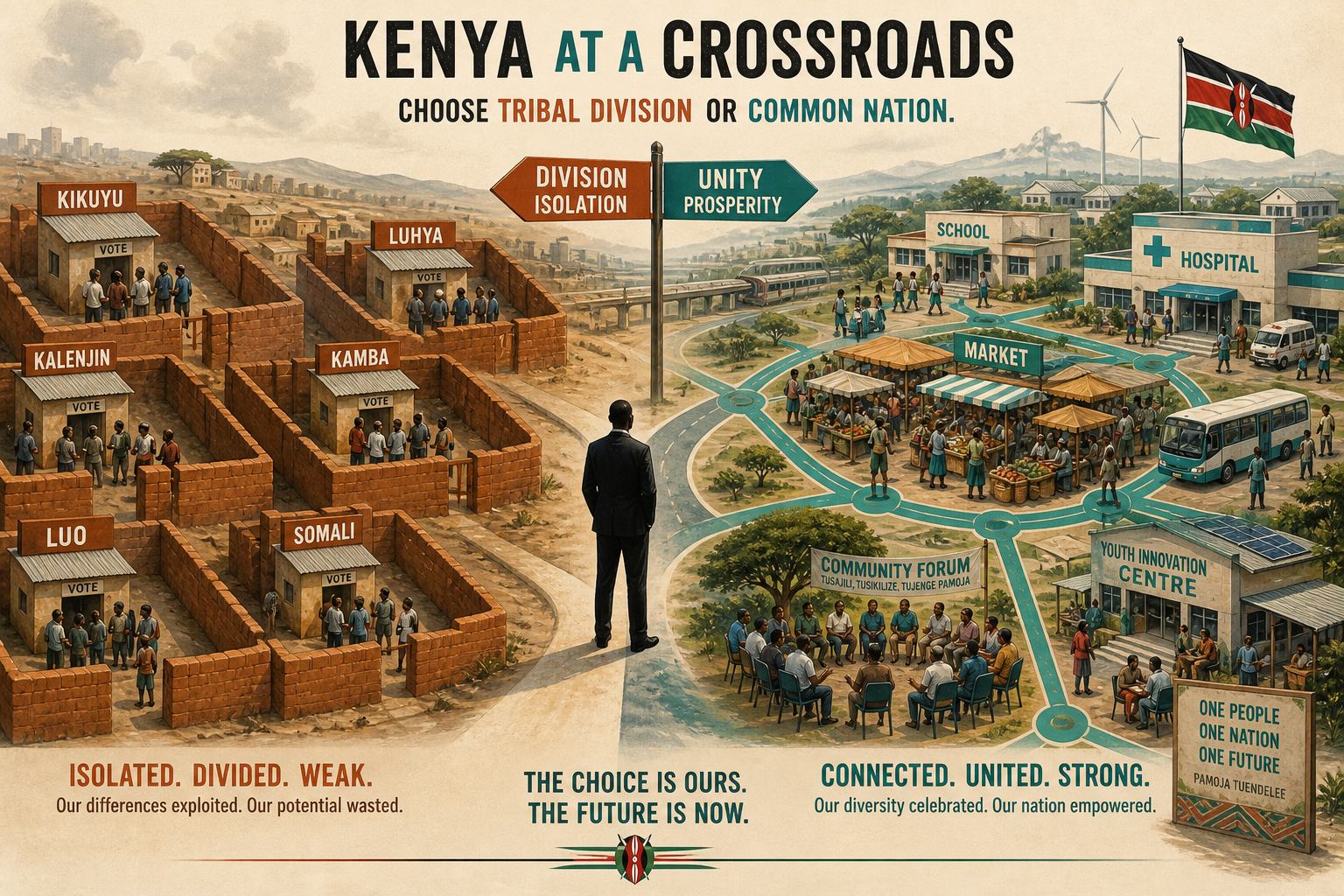
Citizen TV’s The Explainer presented Edwin Sifuna as Kenya’s “man of the moment.” But the more important question is whether his political moment can become a civic movement, one capable of organising citizens around shared values and problems rather than merely rearranging Kenya’s familiar ethnic blocs.
On Tuesday night, a television studio became a miniature polling station.
As Yvonne Okwara questioned Nairobi Senator Edwin Sifuna on Citizen TV’s The Explainer, the conversation moved from his political fallouts and rising popularity to the question that now follows him everywhere:
Will Edwin Sifuna run for President?
It was an understandable question. Kenyan politics loves a new protagonist. We are always searching for the next liberator, regional kingpin, opposition chief or “man of the moment.”
But beneath that question was another, more consequential one:
What kind of political country would a Sifuna candidacy ask Kenya to become?
In Part I of this commentary, I argued that electoral boundaries are not neutral. They influence whom politicians must persuade, who is considered an outsider and whether elections reward ethnic fortresses or civic coalitions.
Sifuna’s interview adds a second proposition:
The candidate is also a map.
A national candidate teaches citizens how to organise themselves. The candidate can ask them to assemble as ethnic shareholders demanding their turn at the State, or as citizens negotiating a common future.
The real significance of Sifuna’s moment therefore lies not in whether he can inherit a political constituency. It lies in whether he can help Kenya imagine a different one.
The Old Political Map Appeared Immediately
Even before the interview, Kenya’s familiar political cartography had already been activated.
Could Sifuna “deliver” Western Kenya? Had he displaced Musalia Mudavadi and Moses Wetang’ula? Had Luhya elders endorsed him? Would his Bungoma homecoming translate into votes? Could he combine a Western Kenya base with Nairobi’s urban youth and the digital energy of Gen Z?
These questions sound analytical, but they carry an old assumption: that regions are political property and citizens are inventory to be delivered.
Western Kenya becomes a voting bloc. Mount Kenya becomes another. The Coast, Ukambani, Nyanza and the Rift Valley are entered into an electoral spreadsheet. Leaders then negotiate with one another as custodians of entire populations.
This is not nation-building. It is elite brokerage.
It may produce a multi-ethnic coalition, but a multi-ethnic coalition is not automatically a civic coalition. Political elites can exchange ethnic blocs without changing the logic of ethnic politics.
Sifuna’s rise is interesting precisely because he complicates that old map. He is a Senator elected by Nairobi, a son of Bungoma, a national television figure and a politician whose momentum is partly propelled by young people, online communities and public gatherings outside his ancestral region.
Yet the political establishment keeps trying to return him to the ethnic box:
Before you become a national leader, prove that you own your people.
That is the very logic Part I challenged. No Kenyan leader should own a community, and no community should be expected to arrive at the national negotiating table as somebody’s luggage.
Watch the conversation
Citizen TV’s The Explainer interviewed Nairobi Senator Edwin Sifuna across two parts. Embeds use YouTube’s privacy-enhanced mode; ordinary links are provided as fallbacks.
Citizen TV, The Explainer: Sifuna: Man of the Moment, Part I
Direct link: https://www.youtube.com/watch?v=99qzycj8Jb4
Citizen TV, The Explainer: Sifuna: Man of the Moment, Part II
Direct link: https://www.youtube.com/watch?v=LB4iNrs5J30
The Strongest Part of Sifuna’s Interview Was Not About Sifuna
The most compelling part of the interview came when Sifuna shifted the discussion from personalities and infrastructure to constitutional values.
He argued that government cannot compensate for violations of human rights, democracy and the rule of law by pointing to roads, stadiums or other visible development projects. He connected political legitimacy to the Constitution’s promises of social justice, equity and equality. He also criticised leadership that refuses to listen when citizens reject a policy. Citizen Digital’s account of the interview captures this constitutional argument.
This matters.
For too long, Kenyan elections have been presented as a choice between development and democracy, as though citizens must tolerate abuse, exclusion or corruption because a government has constructed something.
But roads do not need authoritarianism. Hospitals do not require repression. A democracy can build railways, schools, markets and stadiums while respecting human life.
The Constitution is not an obstacle to development. It is the moral and institutional framework within which development acquires legitimacy.
Sifuna was therefore strongest when he suggested that the opposition’s case should be bigger than dislike of President William Ruto. It should be about the kind of life Kenyans agreed to live when they adopted the 2010 Constitution.
That language aligns with the civic constituency proposed in Part I. It moves politics from:
Who belongs to our side?
to:
What values must govern all of us?
A Movement Bigger Than One Man
Sifuna also resisted making the emerging Linda Mwananchi movement entirely about himself.
When asked about a possible presidential bid, he said the decision would have to be made collectively. He credited young people, online communities and Bunge la Mwananchi for his growing political standing. He added that the movement intends to field candidates for different elective positions and must develop structures through which citizens can participate. Citizen Digital reported these remarks following the interview.
That instinct is correct.
A healthy political movement should be able to survive the absence, defeat or retirement of its most popular leader. If everything depends on one personality, we have not constructed a democratic movement; we have created another political homestead.
The interview therefore raised a useful distinction:
Is Sifuna building a following, or is Linda Mwananchi building an institution?
A following waits for the leader to speak.
An institution has values, rules, local structures, transparent finances, credible candidate-selection processes and mechanisms through which ordinary members can challenge their leaders.
A following asks, “What has Sifuna decided?”
An institution asks, “What have citizens agreed?”
A following
- One central voice; supporters wait to hear
- One-way communication from the leader
- Asks: “What has the leader decided?”
- Collapses if the personality leaves
An institution
- Distributed voice, rules and local structures
- Transparent finance and candidate selection
- Asks: “What have citizens agreed?”
- Survives absence, defeat or retirement of one leader
Sifuna’s greatest contribution would not be to become indispensable. It would be to help create a movement within which no individual is indispensable, including himself.
“Ruto Must Go” Is a Starting Point, Not a Government
The interview also exposed the unfinished work.
Sifuna argued that the movement could cooperate with former Deputy President Rigathi Gachagua despite his earlier support for Gachagua’s impeachment. The proposed basis of cooperation is opposition to President Ruto and a stated commitment to constitutionalism and the rule of law. Citizen Digital reported this position.
Tactical cooperation is not inherently wrong. Democracies are built through negotiation among people who do not agree on everything.
But a coalition organised primarily around removing one person can reproduce the same personalised politics it claims to oppose.
“Ruto must go” may mobilise anger. It does not, by itself, explain what comes next.
A serious civic coalition must answer harder questions:
- What conduct would disqualify a member from the coalition?
- How would candidates be selected?
- What economic programme would address household distress?
- How would public borrowing, taxation and procurement be governed?
- What would prevent State appointments from becoming rewards for coalition financiers and ethnic brokers?
- How would the coalition protect citizens who did not vote for it?
- What happens when powerful coalition members violate the very Constitution that brought them together?
Without clear answers, opposition unity can become another transaction among political shareholders: one leader brings a region, another brings money, another contributes a party certificate, and another supplies crowds.
The faces change. The map remains the same.
A National Candidate Must Pass 290 Local Tests
The Constitution establishes 290 constituencies. Article 89 requires boundary decisions to consider population, geography, urban centres, community interests, historical, economic and cultural ties, and means of communication. The IEBC has also reiterated the constitutional limit of 290 constituencies.
A movement seeking national power should therefore not treat constituencies merely as containers from which votes are harvested.
It should treat each constituency as a civic laboratory.
Linda Mwananchi, or any movement seeking to offer Kenya an alternative, could invite residents in every constituency to develop a Constituency Civic Compact: a short, public agreement identifying the five or six most urgent shared priorities in that locality.
In one constituency, the priorities might be water, livestock markets and insecurity. In another, they may be sanitation, rent, youth employment and public transport. Elsewhere, the compact may focus on irrigation, school retention, fishing infrastructure, industrial pollution or access to healthcare.
Candidates would then be evaluated on their ability to deliver these shared priorities, not on their surname, clan, ethnic endorsement or proximity to a presidential candidate.
A genuinely civic movement would consequently need:
- Open local listening forums involving traders, farmers, workers, professionals, women, young people, persons with disabilities and minority communities.
- Transparent candidate selection, with published criteria and protection against nomination capture by wealthy aspirants.
- Public disclosure of political financing, including money raised through crowdfunding and expenditure on rallies.
- Constituency-level performance scorecards against which elected representatives can be assessed.
- Protection of minority voices, so that civic politics does not become disguised majoritarianism.
- A binding constitutional code governing how coalition partners exercise power, resolve disputes and respond to misconduct.
This would convert a national movement into a network of locally accountable civic constituencies.
Modesty Is a Signal; Institutions Are the Proof
During the interview, Sifuna defended his modest village home and rejected the idea that public office must produce visible opulence. He presented personal restraint as a matter of upbringing and values. Citizen Digital reported his explanation.
That message resonates because Kenyans have been conditioned to treat unexplained wealth as proof that a politician is “development-conscious.”
A leader builds a mansion and the community celebrates. A convoy grows longer and supporters interpret it as political strength. Public office becomes successful when it produces private spectacle.
Sifuna’s modesty challenges that culture.
But personal modesty, while admirable, is not a governance system. Citizens should not have to depend on leaders being “built differently.”
Kenya needs institutions that make integrity normal: transparent procurement, enforceable conflict-of-interest rules, public asset declarations, independent oversight and consequences for abuse of office.
Character matters. Institutions make good character scalable.
The Interview Did Not Settle the Question, and That Is Useful
The two-part Explainer interview did not prove that Sifuna is ready to become President. No television interview can.
It revealed something more useful: the tension between a politician’s popularity and the institutional demands of a national movement.
Sifuna spoke the language of constitutionalism, collective leadership and generational responsibility. These are promising foundations.
But the harder work begins after the applause.
Can the movement publish its rules before it asks for power?
Can it select candidates without reproducing the corruption of established parties?
Can it work with former adversaries without abandoning accountability?
Can it organise communities around shared problems rather than regional kingpins?
Can it survive disagreement without labelling internal critics as traitors?
Can it make Sifuna less important than the values he represents?
Those questions should determine whether this is merely Sifuna’s moment, or the beginning of a different political method.
Kenya Does Not Need Another Owner of the Map
Part I argued that Kenya must stop drawing and interpreting constituencies as ethnic enclosures.
Sifuna’s interview shows that boundary reform alone will not be enough. Even the best electoral map can be recolonised by personality cults, ethnic kingpins and transactional coalitions.
We must also redraw the political imagination.
A movement does not defeat ethnic arithmetic simply by finding a more attractive numerator. It changes the denominator, from tribe to shared life, from regional ownership to constitutional citizenship, and from political inheritance to measurable public responsibility.
The question is therefore not whether Edwin Sifuna can inherit Western Kenya.
No leader should inherit a people.
The question is whether Sifuna, and every other person seeking national leadership, can help citizens organise themselves around a future that no community must fear.
Kenya does not need another hero to own the map.
It needs a civic movement that gives the map back to the people.
And perhaps that is the true test of the “man of the moment”:
Not whether the moment makes him President, but whether he can help make Kenya a republic in which citizenship matters more than political ancestry.
The next ballot should not ask which community has finally found its candidate.
It should ask:
Which candidate has found Kenya in the everyday lives of its people?
From reading to civic action
Movements endure when institutions and shared systems are tended. Learn safeguards, then practice compact and challenge pathways.
Improve this article
Ask a question, suggest a correction, submit a source, share experience, or propose a topic. Contact details stay private. Publicly consequential allegations need editorial review.