When the Institution of Trust Becomes the Risk: A KUSCCO Governance Simulation
KUSCCO's liquidation is not only a story about money. It is a case of evidence, incentives, dissent and accountability failing to meet at the same decision table.
On this page
- The Institution of Trust Becomes the Risk
- What Is Known, and What Is Not
- Governance Was the Asset
- The Four Distances That Compound Risk
- Governance Simulation: The Decision Table
- Pattern Review
- Influence Map: Power Is Not the Same as Exposure
- Team Deliberation and Dissent
- Decision Journal: Four Gates
- A Governance Resolution, Not a Verdict
- What Every Board Should Ask
- Sources and Status
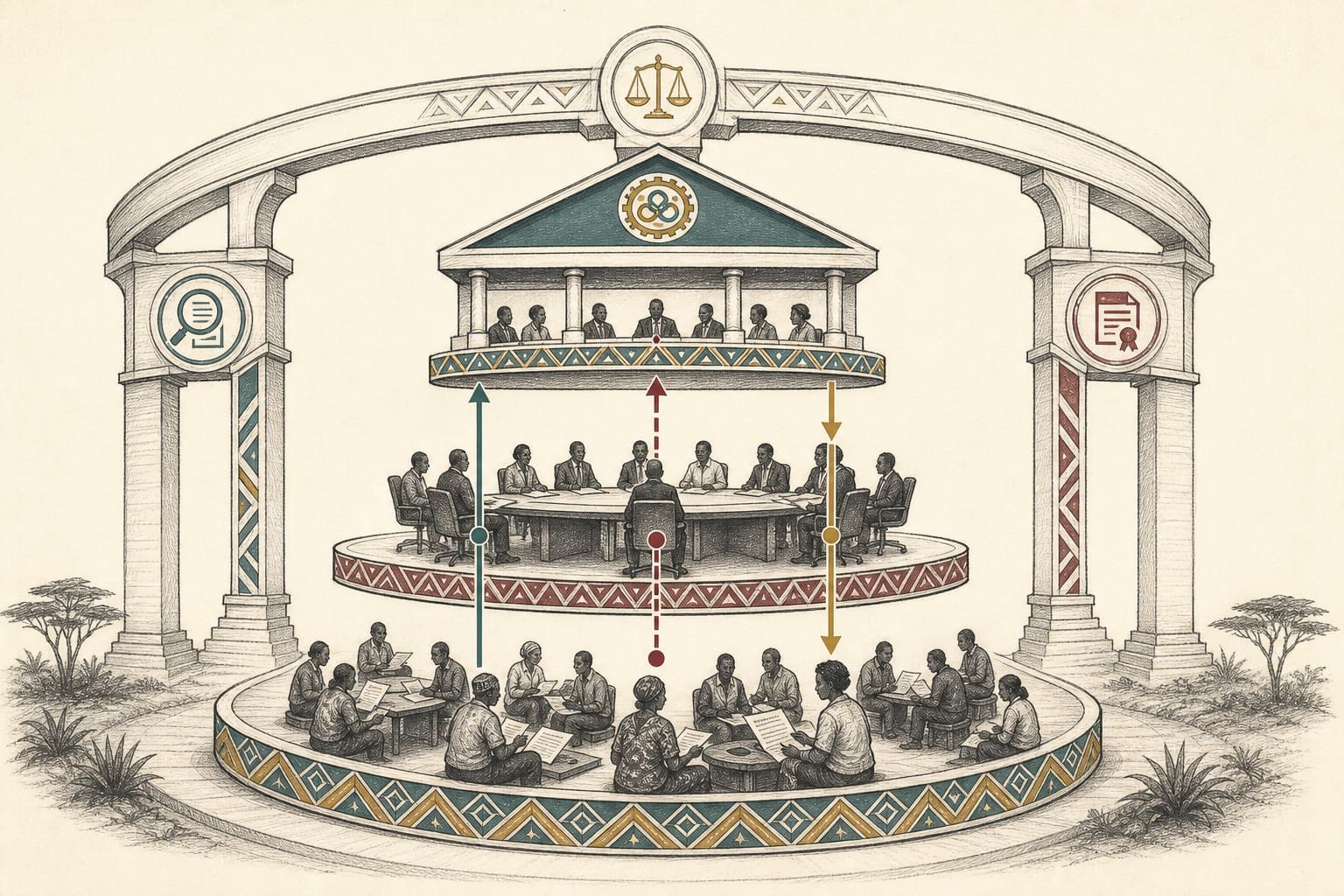
Conceptual editorial image, not a documentary scene and not an allegation against any person. Four institutional layers sit on an ivory ground: savers and members at the base; member SACCO boards above them; an apex co-operative union as the institutional roof; auditors, regulators and liquidators as an outer frame. Quiet arrows mark evidence and dissent travelling upward, and accountability travelling downward. Mood: architectural, restrained, Kenyan civic ink-and-wash. No crime imagery.
The Institution of Trust Becomes the Risk
An umbrella body is supposed to thicken trust. It pools information, bargains at a scale no single savings and credit co-operative can match, and stands between household deposits and the wider financial system. That is the promise of an apex union. The Kenya Union of Savings and Credit Co-operatives, KUSCCO, was built to carry that promise for member SACCOs across the country.
By the last week of August 2026, the same institution had become a concentration point for financial and governance risk. Members voted for structured liquidation on 28 August 2026. Three days later, Kenya Gazette Notice No. 13997 cancelled KUSCCO’s registration and ordered statutory liquidation. “Voluntary liquidation” is a useful shorthand for a member-initiated process. The legal commencement was the Commissioner’s order under the Co-operative Societies Act, Cap. 490.
Triptych on ivory ground: left, commissioner testimony at a desk; centre, member vote in a modest hall; right, Kenya Gazette notice with seal. Teal and ochre editorial ink-and-wash. Illustrative only, not a documentary scene.

The direct story is insolvency. The deeper story is decision architecture. Numbers can be made to carry more authority than the evidence beneath them. Incentives can reward continuity over challenge. Those who bear the ultimate consequences can sit two delegations away from the table where the number is approved. Accountability can fragment across management, boards, auditors, regulators and member institutions until no one owns the moment when an unsupported figure should have been stopped.
This essay does not prosecute. It does not invent a boardroom. It reads the public record as a case study in how institutions decide what counts as evidence, who is allowed to challenge it, and who carries the loss when representation fails. That is the work ThePortal was built to make visible: transparent deliberation, explainable pattern review, compound-risk simulation, documented dissent and a decision journal that can be reopened when the facts change.
What Is Known, and What Is Not
Governance begins by separating what has been established from what is still in motion. The public file on KUSCCO is thick with both. Treat the following as a status board, not a verdict.
Confirmed
Member vote and Gazette commencement.
Audit finding
Overstated income, separate cash-loss and aggregate estimates.
Allegation
Charges filed; no guilt finding in the latest judgment cited.
Estimate
Liabilities, assets and provisional balance-sheet gap.
Unresolved
Litigation totals, recoveries and successor-body firewall.
| Matter | Safe formulation |
|---|---|
| Confirmed statutory facts | Members voted for structured liquidation on 28 August 2026. Registration was cancelled and statutory liquidation ordered on 31 August 2026 through Gazette Notice 13997. |
| Audit / regulatory findings | The Financial Sector Stability Report 2024 records KSh9.3 billion in overstated income from a fraudulent scheme, separately notes KSh206 million in lost member-fund cash, and cites an aggregate loss estimate in the KSh13.3-14.0 billion range. These measures are not interchangeable. |
| Allegations still before courts | Five accused persons faced charges. Charges and audit allegations are not convictions. The High Court judgment of 29 April 2026 left the prosecution active and made no finding of guilt. |
| Financial estimates | Estimates presented to shareholders put liabilities above KSh17 billion and the asset base near KSh5.4 billion. The resulting figure above KSh11.6 billion is a provisional balance-sheet shortfall, not a final realised creditor or retail-member loss. |
| Unresolved recovery and successor questions | Litigation totals conflict in public reporting. Completed registration of a successor federation, and a binding instrument proving that it inherits no KUSCCO debts, were not established in the sources used here. The Gazette is silent on any such transfer. |
Confirmed statutory facts
- Safe formulation
- Members voted for structured liquidation on 28 August 2026. Registration was cancelled and statutory liquidation ordered on 31 August 2026 through Gazette Notice 13997.
Audit / regulatory findings
- Safe formulation
- The Financial Sector Stability Report 2024 records KSh9.3 billion in overstated income from a fraudulent scheme, separately notes KSh206 million in lost member-fund cash, and cites an aggregate loss estimate in the KSh13.3-14.0 billion range. These measures are not interchangeable.
Allegations still before courts
- Safe formulation
- Five accused persons faced charges. Charges and audit allegations are not convictions. The High Court judgment of 29 April 2026 left the prosecution active and made no finding of guilt.
Financial estimates
- Safe formulation
- Estimates presented to shareholders put liabilities above KSh17 billion and the asset base near KSh5.4 billion. The resulting figure above KSh11.6 billion is a provisional balance-sheet shortfall, not a final realised creditor or retail-member loss.
Unresolved recovery and successor questions
- Safe formulation
- Litigation totals conflict in public reporting. Completed registration of a successor federation, and a binding instrument proving that it inherits no KUSCCO debts, were not established in the sources used here. The Gazette is silent on any such transfer.
The headline figure above KSh11.6 billion needs a correction in public conversation. It is the arithmetic of estimated liabilities above KSh17 billion minus an estimated asset base near KSh5.4 billion, as presented to shareholders and reported in contemporary business coverage. A balance-sheet gap is not a final retail-member loss. It is not even, yet, a final creditor loss. Liquidation proceeds are ranked. Costs come off the top. Preferential and secured claims are not the same as unsecured claims. Same-ranking claims may abate proportionately. Recoveries can still arrive. They can also disappoint. Until the estate is wound through proof of debt and distribution, the gap remains provisional.
Asset quality cuts the same way. Contemporary reporting on the audit said an adequate asset register was absent and parts of the loan book lacked support. Do not call the entire KSh5.4 billion recoverable cash. Do not, either, treat it as already written off to zero. The honest statement is narrower: the public record does not yet show which assets can be realised, at what cost, and for whom.
The KSh9.3 billion figure is equally easy to misuse. The Kenya Financial Sector Stability Report 2024, in the co-operative section around pages 79-80, describes KSh9.3 billion in overstated income from a fraudulent scheme. That is an accounting overstatement finding. It is not proof that KSh9.3 billion in cash left the building. The same official report separately mentions KSh206 million in lost member-fund cash and an aggregate loss estimate in the KSh13.3-14.0 billion range. Adding those measures, or swapping one for another, produces a more dramatic number and a worse description of reality.
On 6 August 2026, parliamentary records of the Commissioner’s testimony addressed the overstated loan book and the regulatory response. That testimony is part of the official file. It is not a substitute for a completed liquidation account.
Criminal process must be held at arm’s length from recovery process. A DCI statement dated 14 February 2025 described initial charges and continuing investigations. Five accused persons faced charges. Charges are not convictions. In Ototo v Inspector General of Police, decided on 29 April 2026, the High Court addressed procedural status and made no finding of guilt. The prosecution remained active. A governance simulation that forgets that distinction becomes a second courtroom it has no authority to convene.
Litigation totals are not settled. Business Daily reported 292 active files claiming KSh6.48 billion; KNA contemporaneously reported 291 files seeking more than KSh16 billion. Present that as a conflict in scope or definition, not as a single authoritative total. The estate will not be clarified by picking the more alarming of two press figures.
Member impact is also easy to flatten. KUSCCO’s direct creditors include member SACCOs. Individual savers normally feel the shock indirectly: through their own SACCO’s impairment, capital, liquidity, lending capacity and dividends. KUSCCO’s liquidation does not automatically liquidate member SACCOs or erase retail deposits. That is why the vocabulary of exposure matters.
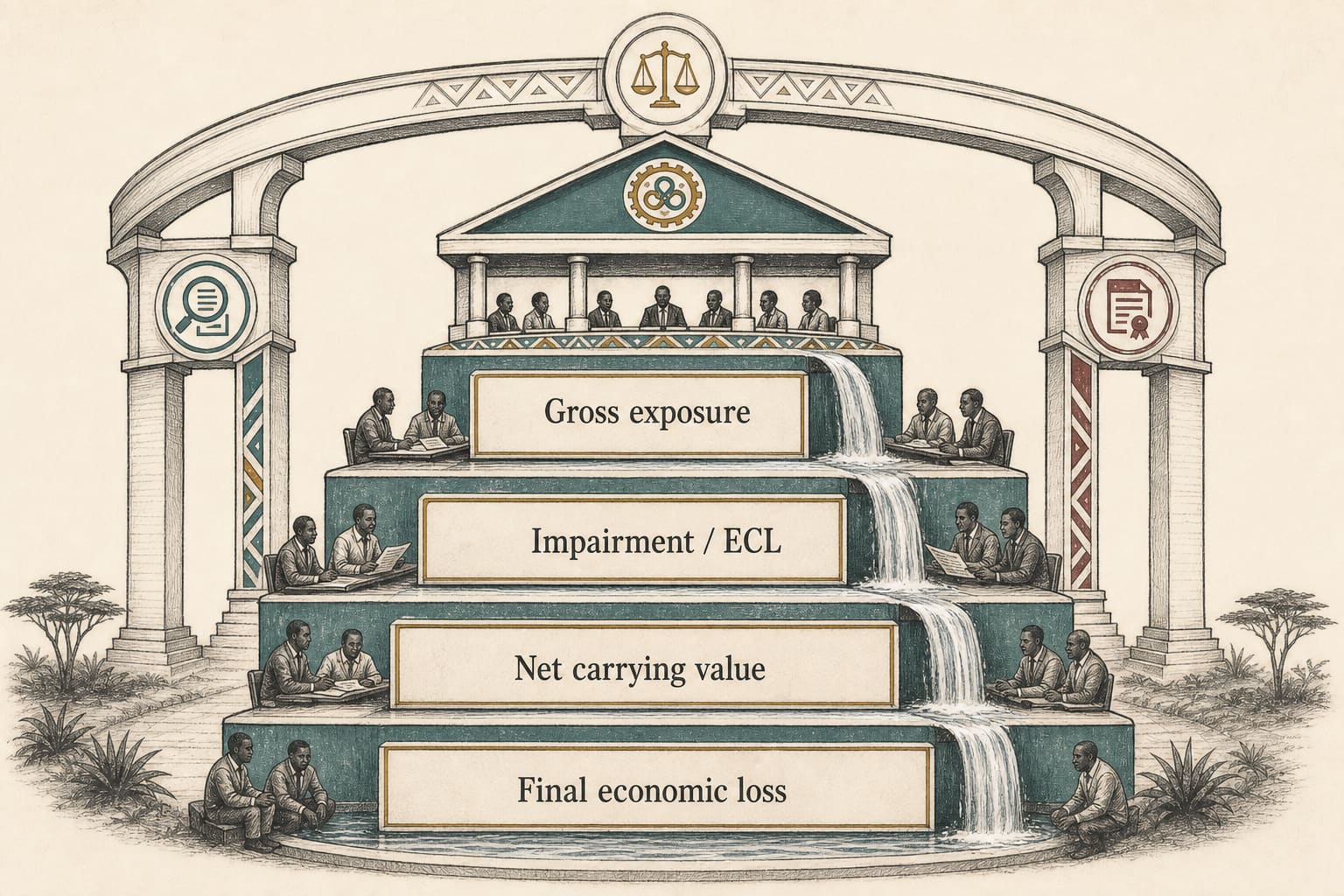
Four-step waterfall cascade on ivory paper: gross exposure widest at top, final economic loss narrowest at bottom. Each step labelled. Conceptual editorial illustration, not a data chart.
| Measure | Meaning |
|---|---|
| Gross exposure | The contractual claim before impairment. |
| Impairment / ECL | The accounting loss already charged against surplus. |
| Net carrying value | Gross exposure less impairment, what remains on the books. |
| Final economic loss | Known only after distributions, recoveries, costs and unresolved litigation. |
Gross exposure
- Meaning
- The contractual claim before impairment.
Impairment / ECL
- Meaning
- The accounting loss already charged against surplus.
Net carrying value
- Meaning
- Gross exposure less impairment, what remains on the books.
Final economic loss
- Meaning
- Known only after distributions, recoveries, costs and unresolved litigation.
If circulating graphics used four SACCO examples, the public record requires a correction before those names are repeated as if they were final losses.
| SACCO | Controlled description |
|---|---|
| Balozi | Approximately KSh437.6 million was the December 2024 net carrying value, after impairment. It was not a confirmed final loss. |
| Mhasibu | A circulating figure of KSh408 million is not supported by the later record. The Co-operative Tribunal ordered payment of approximately KSh489.5 million. |
| Kimisitu | Approximately KSh353.9 million was the gross deposit exposure, already fully impaired to zero carrying value in the 2024 accounts. Full impairment does not extinguish the legal claim. |
| Qona | The reported 2024 gross exposure was approximately KSh134.7 million, not a higher circulating figure of KSh314 million. |
Balozi
- Controlled description
- Approximately KSh437.6 million was the December 2024 net carrying value, after impairment. It was not a confirmed final loss.
Mhasibu
- Controlled description
- A circulating figure of KSh408 million is not supported by the later record. The Co-operative Tribunal ordered payment of approximately KSh489.5 million.
Kimisitu
- Controlled description
- Approximately KSh353.9 million was the gross deposit exposure, already fully impaired to zero carrying value in the 2024 accounts. Full impairment does not extinguish the legal claim.
Qona
- Controlled description
- The reported 2024 gross exposure was approximately KSh134.7 million, not a higher circulating figure of KSh314 million.
Kimisitu’s own 2024 audited accounts are the reason the gross-versus-carrying distinction is not academic. Full impairment is an accounting recognition. It does not extinguish a legal claim. Mhasibu’s later position is likewise a matter of record: Mhasibu DT SACCO v KUSCCO, decided by the Co-operative Tribunal on 30 July 2026, ordered payment of approximately KSh489.5 million. A screenshot is a claim until a judgment or an audited line item can carry it.
Reporting on how SACCOs provisioned KUSCCO exposure matters for the same reason. Different boards recognised the same shock at different speeds and with different labels. That is not a minor bookkeeping quarrel. It is the lived distance between a contractual claim and a member dividend.
A proposed successor federation, reported as KEFESCCO, was approved by shareholders for formation and registration. Completed registration, and a binding instrument proving that the new body inherits no KUSCCO debts, were not established in the sources used for this brief. The Gazette is silent on a transfer. A High Court challenge has already asked that reorganisation be halted over creditor risk. Until a primary instrument is on the table, “successor” is a political wish, not a legal firewall.
One drafting curiosity in Notice 13997 should be noted without being inflated. The notice cites section 62(1)(f). The current Kenya Law text of Cap. 490 appears to place failure to achieve objects under section 62(1)(c). An apparent cross-reference mismatch is not proof of invalidity. It is a reminder that even the instruments of closure deserve the same evidence discipline the rest of this case demands.
Governance Was the Asset
A financial co-operative union holds more than money. It holds delegated trust. It holds an information advantage over the member institutions that send it deposits, buy its services and vote its board. It holds collective bargaining power. It holds the confidence that a shared balance sheet is a shared defence.
When evidence quality weakens, that architecture is itself impaired. The loan book is no longer only a financial asset. It becomes a claim about reality that other people must live inside. If the claim cannot be reproduced from original documents, the institution is no longer merely at risk of loss. It has become the mechanism by which loss is delayed, renamed or passed down the chain of representation.
African co-operative governance is particularly exposed to this failure mode because it runs on nested trust. The household trusts the primary SACCO. The primary SACCO trusts the apex union. The apex union trusts management, the auditor and the regulator to catch what the members cannot see. Each layer is rational. Together they can produce a silence that no single actor intended.
The question, then, is not only “where did the money go?” That question belongs to investigators, liquidators and courts. The governance question is prior and blunter: what would have had to be true, at each decision gate, for an unsupported number to survive? Who was rewarded for not asking? Who lacked standing to ask? Who could have reopened the decision when the evidence changed, and did the minutes show that right?
Layer 4
Auditors, regulators, liquidators
Assurance, statutory and recovery mandates on different clocks. Power is not the same as exposure, and none of these boxes is a guilt map.
Layer 3
Apex union (KUSCCO)
Held delegated trust, information advantage and operational control. When evidence quality weakens, this layer becomes the risk.
Layer 2
Member SACCOs
Hold the voting and claim relationship with the apex body. Must disclose exposure, mandate and recusals to the people they represent.
Layer 1
Retail SACCO members
Bear consequences through their own SACCO’s impairment, liquidity and dividends. Low direct apex power; need plain-language disclosure.
Flows between layers: evidence upward · dissent upward · accountability downward
The Four Distances That Compound Risk
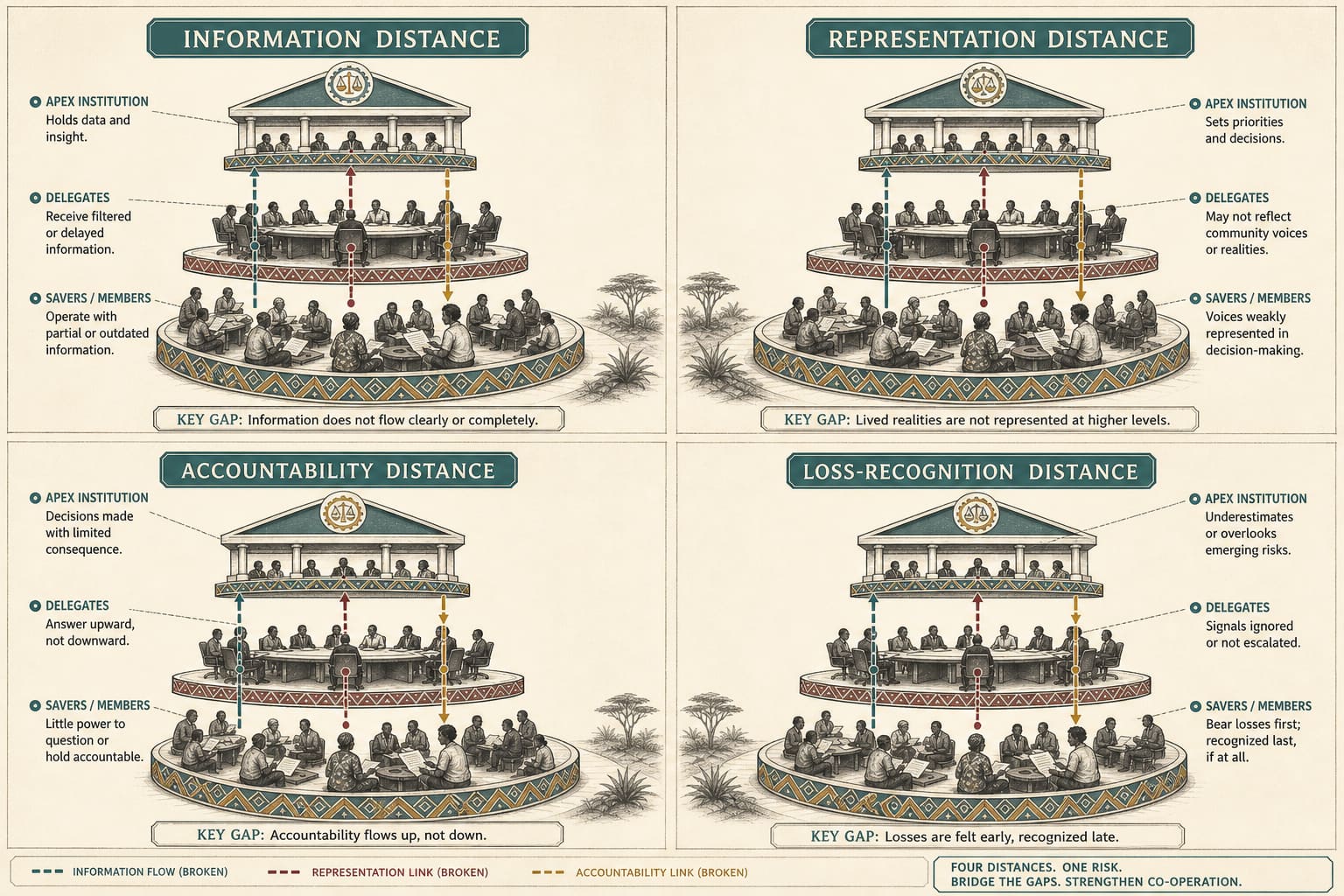
Compound risk is not a mysterious force. It is distance, between those who see, those who decide, those who are answerable, and those who pay, left unbridged for too long.
2×2 grid of broken bridges between institutional layers: information, representation, accountability, loss-recognition. Savers at base, delegates middle, apex at top. Illustrative only.
Information distance
Management and auditors see records before member SACCOs do. Member SACCOs see them before retail savers do. By the time a household hears that “KUSCCO is in trouble,” the figure on the table may already have been impaired, restated, disputed or overtaken. Opacity is not always a conspiracy. Sometimes it is a filing calendar. The governance failure is the same: people who will live with the number cannot test it while it is still reversible.
Representation distance
Retail members delegate to primary SACCOs. Primary SACCOs delegate to the apex union. Formal representation exists at every layer. Lived consequence does not travel as neatly. A delegate can vote a liquidation resolution in Nairobi while a member in Kisii experiences the same event as a tighter loan, a delayed dividend, or a rumour. Distance of this kind is not cured by another press conference. It is cured by disclosure that a member can use.
Accountability distance
The board, management, the external auditor, the Commissioner, SASRA, investigators and the courts have different mandates and different clocks. Each can be acting in good faith while the system as a whole produces delay. “Who was responsible?” is the wrong first question if it is asked as a hunt for a single villain. The better first question is: which mandate owned which gate, and what evidence was required to pass it?
Loss-recognition distance
Gross exposure, impairment, net carrying value and final recovery are recognised at different times, by different institutions, under different standards. Boards that delayed impairment did not thereby reduce the contractual claim. Boards that fully impaired a deposit did not thereby extinguish it. Households experienced the shock through whichever of these clocks their own SACCO happened to be using. Governance that cannot name the clock will always over-claim a loss or under-warn a member.
Governance Simulation: The Decision Table
The simulated decision is deliberately narrow:
What recovery and member-protection pathway should KUSCCO adopt once insolvency, unreliable records and inadequate recapitalisation capacity are evident?
ThePortal did not exist at these gates. This exercise does not pretend otherwise. It asks what a competent board, audit and risk committee, regulator, member-SACCO delegate, creditor, auditor and saver representative should have seen, asked, documented and escalated, using only what the public record already makes available. No private minutes are invented. No motive is assigned. No score is treated as a decision.
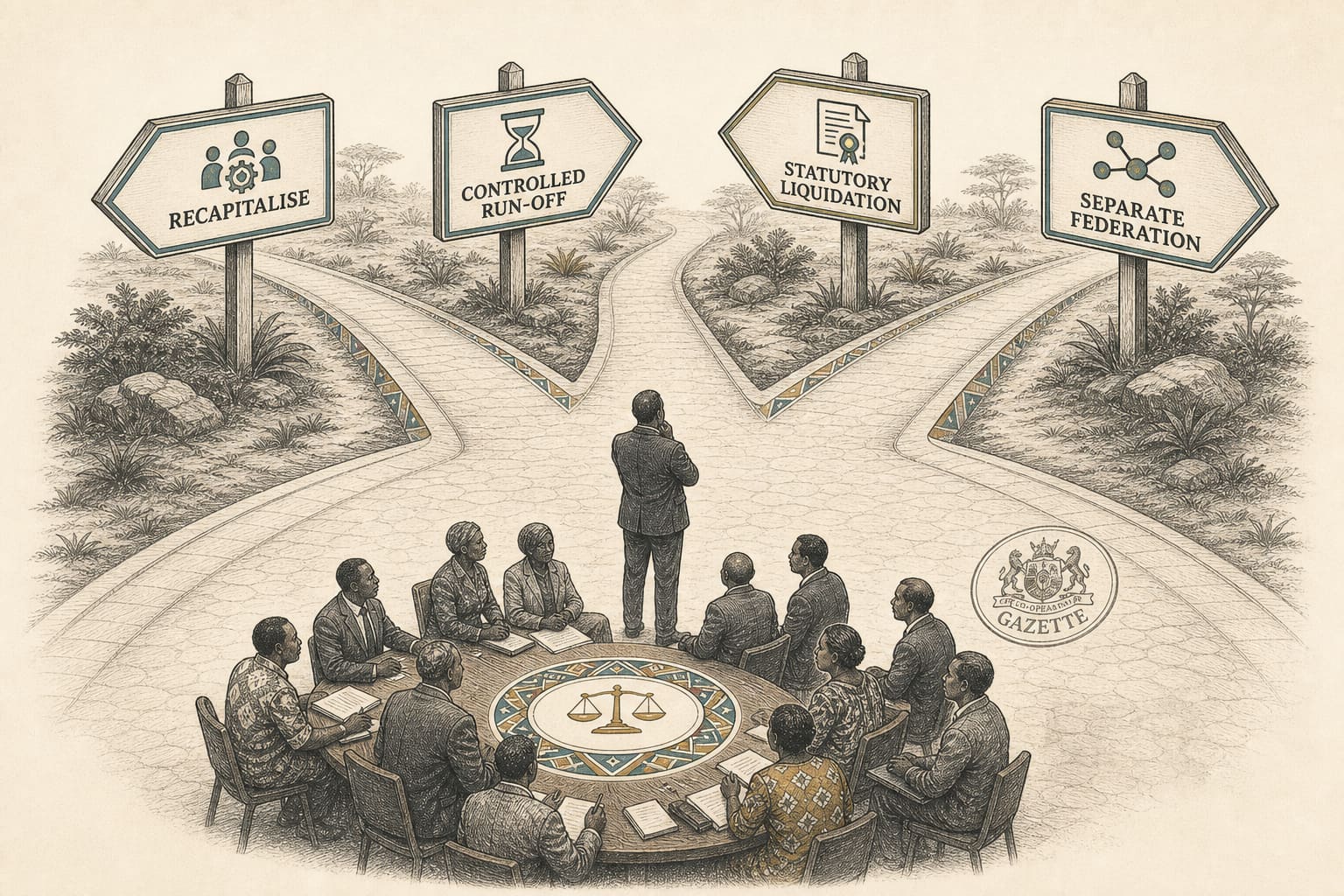
Four options sit on the table. None of them is made legitimate by a percentage.
Bird’s-eye fork in a path with four signposts: Recapitalise, Controlled run-off, Statutory liquidation, Separate federation. One route marked with a Gazette seal. Educational simulation only.
Recapitalise and continue
- Reversibility
- High if capital actually arrives; low if new money is raised on incomplete books.
- Evidence required
- Independently verified asset and liability register; proof that new capital can be raised and ring-fenced.
- Liquidity
- Requires a large cash injection. Auditors reportedly estimated roughly KSh14 billion.
- Legal authority
- Member and regulatory consent; continuing licence and prudential capacity.
- Implementation capacity
- Constrained on the public record: recapitalisation was not the route members chose.
- Creditor treatment
- May preserve going-concern recoveries if the books can be trusted; otherwise it prices hope.
- Lock-in risk
- Continuing on unsupported figures can lock the institution into further misstatement.
Controlled run-off
- Reversibility
- Medium: operations can later be widened or narrowed if records improve.
- Evidence required
- Working collection systems, titles, recoverable loan files and a live claims ledger.
- Liquidity
- Stops new risk-taking; cash depends on collections, not new deposits or new lending.
- Legal authority
- Board and Commissioner alignment on a wind-down mandate short of cancellation.
- Implementation capacity
- Assumes staff, systems and legal capacity that the public record does not confirm.
- Creditor treatment
- Can improve recoveries if the machine for collecting still exists.
- Lock-in risk
- Lower than cancellation, but delay can still transfer value to faster claimants.
Statutory liquidation
- Reversibility
- Low. Cancellation of registration is a legal lock-in.
- Evidence required
- Gazette authority; liquidators; proof-of-debt process; asset realisation plan.
- Liquidity
- Realisations fund costs, preferential claims and then ranking creditors, not equal shares.
- Legal authority
- Commissioner of Co-operatives under the Co-operative Societies Act; Gazette Notice 13997 is the public instrument.
- Implementation capacity
- Depends on liquidators, courts and the quality of the records they inherit.
- Creditor treatment
- Statutory ranking, security and proof of debt decide who is paid, and in what order.
- Lock-in risk
- Hard to reverse. Successor transfers, if any, can compound the lock-in.
Separate future federation
- Reversibility
- Low if assets, data, goodwill or membership quietly move; high if a true firewall holds.
- Evidence required
- Registration instrument; independent valuation; creditor consent; proof that no unpriced transfer occurs.
- Liquidity
- A new advocacy body does not, by itself, repair the old balance sheet.
- Legal authority
- Must not be implied from a member vote alone. The Gazette is silent on a transfer.
- Implementation capacity
- Easy to announce; hard to police without disclosure and independent review.
- Creditor treatment
- At risk if the new body inherits opportunity while the old estate inherits the debts.
- Lock-in risk
- Irreversible if members, data or contracts leave the estate before claims are verified.
Recapitalise-and-continue is the option that sounds like institutional loyalty. On the public record it was the most expensive in cash and the most demanding of evidence. Auditors reportedly estimated that roughly KSh14 billion in new capital would be required. Members did not choose this route. A board that preferred it would have needed to show that the books being recapitalised were no longer the books that had been overstated.
Controlled run-off is the option that sounds like prudence. It only works if the machine for collecting still exists: titles, files, staff, systems, legal capacity. If those are the very things the audit could not find, run-off is a slogan attached to a hollow institution.
Statutory liquidation is the option the Gazette executed. It is the most legally legible path once cancellation is the chosen instrument. It is also the least reversible. Its integrity depends on what liquidators inherit and on whether ranking is published before money moves.
A separate future federation is not, by itself, a recovery pathway. It can be a legitimate home for advocacy and training. It becomes a governance hazard the moment assets, goodwill, data, membership lists or economic opportunity leave the insolvent estate without lawful authority, independent valuation, transparent disclosure and creditor safeguards. The member vote to form such a body is not evidence that the firewall exists.
You can load this same decision into ThePortal’s Decision Review as a labelled educational fixture, then stress-test how the eight governance patterns compound in the Risk Simulator. The numbers those tools produce are illustrative compound-risk indications. They are not findings, predictions, or a substitute for liquidators and courts.
Pattern Review
ThePortal’s governance patterns are explainable flags, not moral scores. Mapped against the public facts, they read as follows.
Data opacity
Missing registers; unsupported loan-book figures.
Incentive distortion
Continuity, dividends or speed over challenge.
Accountability ambiguity
Shared responsibility without a named verifier.
Participation asymmetry
Savers distant from the apex table.
Implementation-capacity gap
Recovery assumes systems that may not exist.
Conflict-of-interest exposure
Alleged interests need declaration and testing.
Irreversible lock-in
Cancellation and successor transfers hard to unwind.
Minority exclusion
Smaller creditor SACCOs with weaker voice.
| Pattern | Careful reading of the public record |
|---|---|
| Data opacity | Missing or unsupported records, overstated income, and an asset register that could not be independently reproduced. |
| Incentive distortion | Pressure to preserve reported performance, distributions, institutional continuity or transaction speed can reward silence over challenge. |
| Accountability ambiguity | Responsibility is dispersed across executives, directors, auditors, the Commissioner, SASRA, investigators and courts, each with a different mandate and clock. |
| Participation asymmetry | Retail savers carry consequences but do not sit directly at the apex decision table. Representation is delegated twice. |
| Implementation-capacity gap | A recovery strategy may assume asset registers, collection systems, legal capacity or liquidity that the public record does not show exist. |
| Conflict-of-interest exposure | Alleged or undisclosed interests must be tested through declarations, recusals and independent review. An unproved conflict is not a fact. |
| Irreversible lock-in | Cancellation, asset transfers and any successor-entity move can create consequences that are costly or impossible to unwind. |
| Minority exclusion | Smaller creditor SACCOs and less organised member groups may have weaker voice, weaker information, or both. |
Data opacity
- Careful reading of the public record
- Missing or unsupported records, overstated income, and an asset register that could not be independently reproduced.
Incentive distortion
- Careful reading of the public record
- Pressure to preserve reported performance, distributions, institutional continuity or transaction speed can reward silence over challenge.
Accountability ambiguity
- Careful reading of the public record
- Responsibility is dispersed across executives, directors, auditors, the Commissioner, SASRA, investigators and courts, each with a different mandate and clock.
Participation asymmetry
- Careful reading of the public record
- Retail savers carry consequences but do not sit directly at the apex decision table. Representation is delegated twice.
Implementation-capacity gap
- Careful reading of the public record
- A recovery strategy may assume asset registers, collection systems, legal capacity or liquidity that the public record does not show exist.
Conflict-of-interest exposure
- Careful reading of the public record
- Alleged or undisclosed interests must be tested through declarations, recusals and independent review. An unproved conflict is not a fact.
Irreversible lock-in
- Careful reading of the public record
- Cancellation, asset transfers and any successor-entity move can create consequences that are costly or impossible to unwind.
Minority exclusion
- Careful reading of the public record
- Smaller creditor SACCOs and less organised member groups may have weaker voice, weaker information, or both.
Notice what this mapping refuses to do. It does not say that a named person is corrupt. It does not convert an alleged interest into a proved one. It does not treat a pattern flag as a finding of liability. It says: these are the ways a decision system can fail even when every actor claims to be doing their job. That is why Decision Review prints the rule that fired, the evidence still needed, and the question that would falsify the flag. Colour is never the only signal. A readiness bar is never a certificate.
Influence Map: Power Is Not the Same as Exposure
The live Influence Map can load this case as an educational fixture in demo mode. The table below remains the authoritative accessible version, it is not a guilt map.
Node network on ivory ground: retail members, SACCOs, apex union centre, auditors, regulator, liquidators, courts. Subtitle power not equal exposure. Not a guilt map.
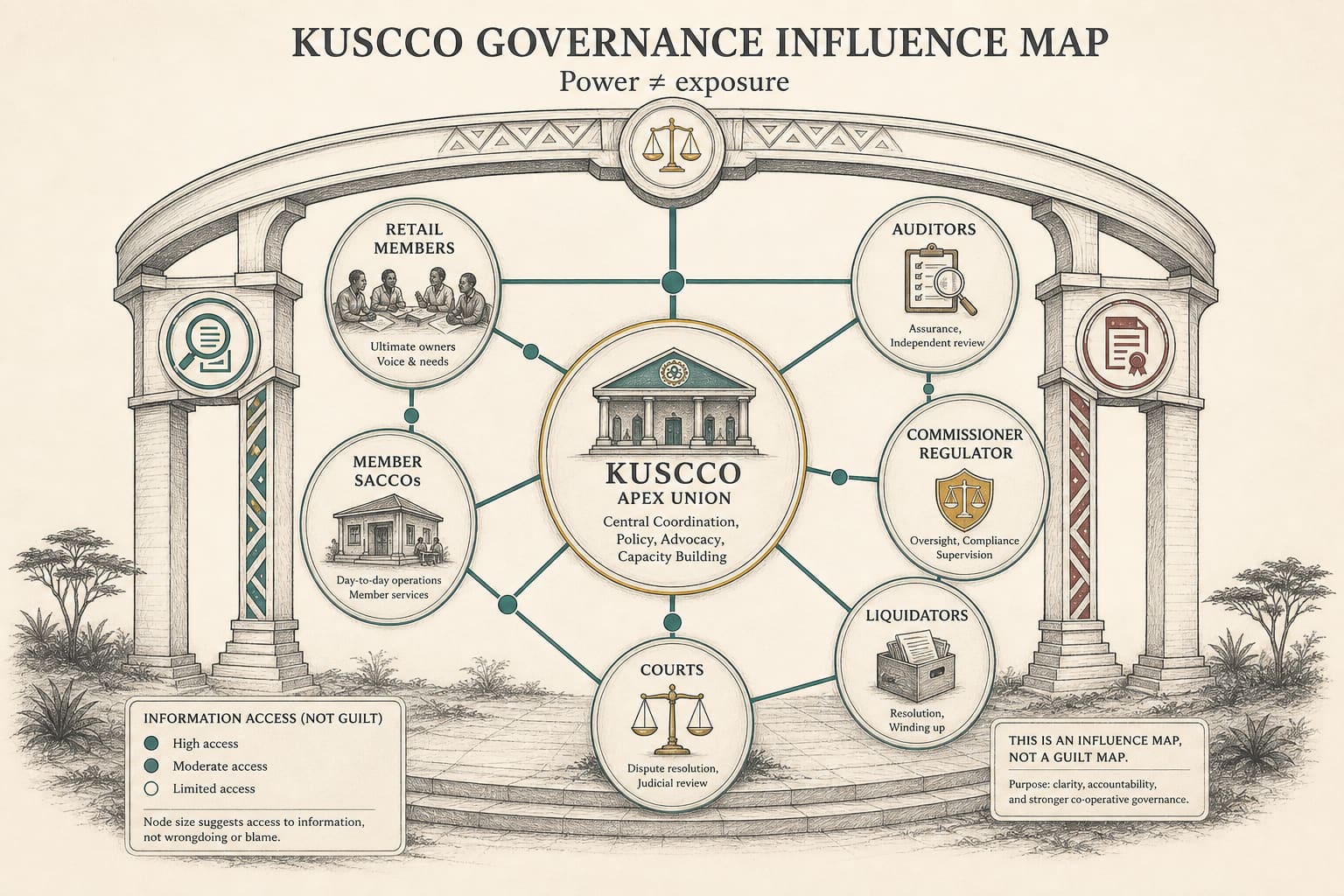
| Actor | Formal power | Information access | Financial exposure | Required governance safeguard |
|---|---|---|---|---|
| Retail SACCO members | Low direct apex power | Low | Indirect but potentially significant | Plain-language disclosure and member representation |
| Member SACCO boards / delegates | Voting and oversight power | Medium | Direct institutional claims | Exposure disclosure, mandate and recusal rules |
| KUSCCO board / management | Operational and information control | High | Fiduciary / institutional | Segregation of duties and verified reporting |
| External auditors | Assurance influence | High access to records | Professional exposure | Independence, rotation, escalation and evidence retention |
| Commissioner / regulators | Statutory and prudential powers | High when engaged | Systemic mandate | Timely intervention and role clarity |
| Creditors / liquidators | Claim and recovery authority | Varies | Direct | Transparent proof-of-debt and distribution process |
| Investigators / courts | Investigative / adjudicative power | Case-specific | Public-interest mandate | Due process and asset-preservation orders |
Retail SACCO members
- Formal power
- Low direct apex power
- Information access
- Low
- Financial exposure
- Indirect but potentially significant
- Required governance safeguard
- Plain-language disclosure and member representation
Member SACCO boards / delegates
- Formal power
- Voting and oversight power
- Information access
- Medium
- Financial exposure
- Direct institutional claims
- Required governance safeguard
- Exposure disclosure, mandate and recusal rules
KUSCCO board / management
- Formal power
- Operational and information control
- Information access
- High
- Financial exposure
- Fiduciary / institutional
- Required governance safeguard
- Segregation of duties and verified reporting
External auditors
- Formal power
- Assurance influence
- Information access
- High access to records
- Financial exposure
- Professional exposure
- Required governance safeguard
- Independence, rotation, escalation and evidence retention
Commissioner / regulators
- Formal power
- Statutory and prudential powers
- Information access
- High when engaged
- Financial exposure
- Systemic mandate
- Required governance safeguard
- Timely intervention and role clarity
Creditors / liquidators
- Formal power
- Claim and recovery authority
- Information access
- Varies
- Financial exposure
- Direct
- Required governance safeguard
- Transparent proof-of-debt and distribution process
Investigators / courts
- Formal power
- Investigative / adjudicative power
- Information access
- Case-specific
- Financial exposure
- Public-interest mandate
- Required governance safeguard
- Due process and asset-preservation orders
The pattern is almost architectural. Those with the highest information and operational control are not those with the most direct household exposure. Those with the most direct household exposure have the least apex voice. Liquidators arrive late, with high formal power over a damaged record. Courts arrive with a public-interest mandate and a duty of due process that forbids the rest of us from treating a charge sheet as a conclusion. Governance is the work of making those mismatches visible before the next irreversible step.
Team Deliberation and Dissent
A competent decision table for this case would not have been a closed management meeting. The educational fixture in Team Participation seats the roles that should have been in the room, or formally observing it.
Circular table with nine labelled empty chairs around it. Centre reads evidence, dissent, accountability. No named portraits. Co-operative governance deliberation scene.
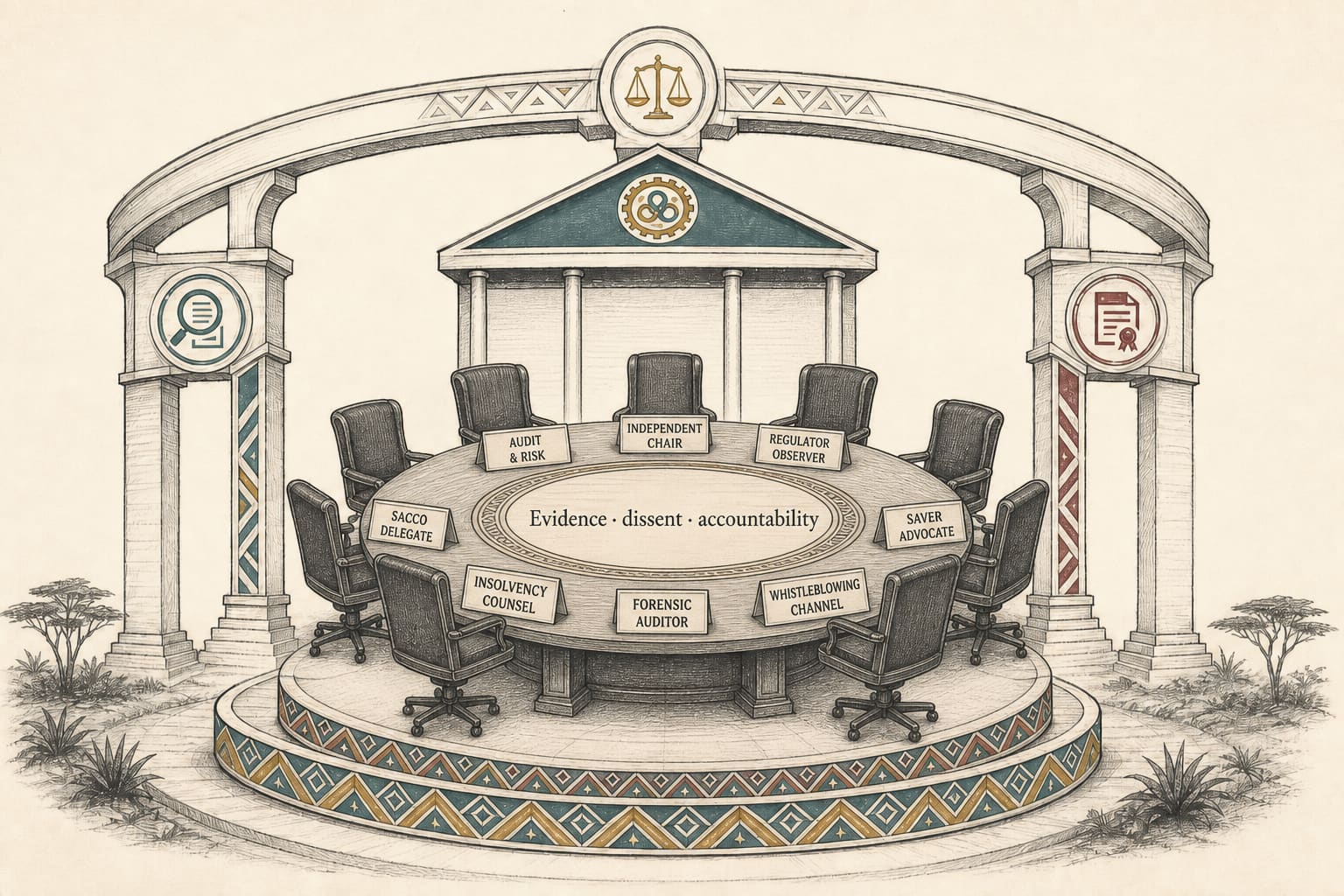
- independent chair or facilitator;
- audit and risk committee representative;
- Commissioner or regulator observer;
- member-SACCO delegate;
- ordinary saver and member advocate;
- creditor and insolvency counsel;
- forensic auditor;
- internal-audit or whistleblowing channel representative;
- independent recovery and asset-valuation specialist.
Each role should disclose interests, name the evidence relied on, record uncertainty, and state what would change their position. Dissent is not disloyalty. In ThePortal it is recorded to improve decision quality, not to rank or penalise participants. The channels that should remain open are ordinary and specific:
- formal dissent entered in the minutes;
- anonymous evidence or red-flag submission;
- conflict declaration and recusal;
- request for independent verification;
- minority creditor or member note;
- escalation to regulator, investigator or court where legally appropriate;
- a reopen right when new evidence changes the decision.
If smaller creditor SACCOs feared a successor transfer, that fear belongs in the minutes whether or not it later becomes a pleading. If a recovery specialist says the asset register cannot support a run-off, that is not pessimism. It is capacity evidence. If a saver advocate cannot see the difference between impairment and a lost deposit, the disclosure, not the advocate, has failed.
Decision Journal: Four Gates That Should Remain Visible
The Console Decision Journal can load retrospective gates for this case in demo mode. The educational journal published here is not claimed as copies of actual minutes.
2023
Inspection warning
Unsupported loan-book reliance continues.
2024
Forensic findings
Overstatement findings require restatement.
2025
Investigation stage
Recovery must proceed without prejudging guilt.
2026
Insolvency decision
Recapitalisation, run-off or liquidation compared.
2023 inspection warning
- Evidence available
- Public later record of inspection concern about the loan book and the quality of supporting records.
- Evidence missing
- A member-facing, independently verified asset and liability register at the time.
- Decision owner
- Board, audit and risk committee, and the Commissioner’s inspection function.
- Dissent recorded
- Any challenge to unsupported balances should have been minuted, not absorbed into continuity.
- Conflicts disclosed
- Related-party lending and management representations required declaration and testing.
- Mitigation
- Pause reliance on unsupported loan-book figures; demand a verified register.
- Follow-up
- Immediate restatement timetable.
- Reopening trigger
- Any material inability to reproduce a balance from original documents.
2024 forensic findings
- Evidence available
- Official regulators’ reporting of overstated income, a separate cash-loss figure, and a wider loss estimate.
- Evidence missing
- A public, line-by-line bridge from overstatement to recoverable cash.
- Decision owner
- Board; forensic reviewers; external auditors; prudential authorities.
- Dissent recorded
- Member SACCOs entitled to see which numbers were findings and which remained estimates.
- Conflicts disclosed
- Anyone with an interest in continued distributions needed recusal from the restatement decision.
- Mitigation
- Preserve records, restate where required, quantify exposures, suspend unreliable performance distributions, name mitigation owners.
- Follow-up
- Exposure disclosures to member SACCOs and their boards.
- Reopening trigger
- Discovery of further unsupported income or missing titles.
2025 investigation and recovery
- Evidence available
- DCI statement on charges and continuing investigations; later High Court procedural status without a guilt finding.
- Evidence missing
- A completed recovery map that does not depend on the outcome of criminal trials.
- Decision owner
- Investigators, asset-preservation applicants, boards of creditor SACCOs.
- Dissent recorded
- Due-process objections and recovery-first objections can both be recorded without collapsing into one.
- Conflicts disclosed
- Accused persons, if still in any residual institutional role, required full recusal.
- Mitigation
- Pursue lawful recovery and asset preservation while separating allegations from findings of guilt.
- Follow-up
- Periodic public recovery dashboard.
- Reopening trigger
- New preservation orders, new titles, or a change in prosecutorial status.
2026 insolvency decision
- Evidence available
- 28 August member resolution; 31 August Gazette Notice 13997; shareholder estimates of liabilities, assets and the gap.
- Evidence missing
- A legally evidenced successor instrument; a settled litigation total; a final realised-loss figure.
- Decision owner
- Members in general meeting; Commissioner; appointed liquidators.
- Dissent recorded
- Objections to successor transfers, minority-creditor notes, and employee/run-off capacity concerns.
- Conflicts disclosed
- Any interest in a new federation’s assets, data or membership required independent review.
- Mitigation
- Compare recapitalisation, run-off and liquidation; document why the chosen route best protects recoveries; impose successor-body safeguards.
- Follow-up
- Proof-of-debt timetable and ranking methodology before distributions.
- Reopening trigger
- A primary instrument transferring value, or evidence that records can still support run-off.
Read down the “evidence missing” column and the case changes shape. The failure is not only that money was at risk. The failure is that several gates could be passed without a reproducible register, without a named owner of verification, and without a recorded right to reopen. That is a decision-architecture failure.
A Governance Resolution, Not a Verdict
The simulation ends where a responsible table should end: not with a denunciation, but with controls that would still be valid if tomorrow’s evidence is better than today’s, or worse.
Illustrative resolution
- Commission an independently verified asset, liability and claim register.
- Secure records, accounts, titles, systems and recovery evidence.
- Publish a clear proof-of-debt process and creditor timetable.
- Require affected SACCOs to disclose gross exposure, impairment, net carrying value and capital/liquidity effects to members.
- Separate recovery actions from criminal guilt; pursue claims without prejudging accused persons.
- Publish the creditor-ranking and distribution methodology before distributions.
- Prohibit transfers of assets, goodwill, data, contracts, membership relationships or economic opportunities to a successor body without lawful authority, independent valuation, transparent disclosure and creditor safeguards.
- Publish periodic recovery dashboards showing opening claims, verified claims, assets identified, cash realised, costs, distributions and unresolved litigation.
- Assign named mitigation owners and preserve dissent and reopen rights.
- If attestation is used at all, attest only that this governance process was completed, not institutional virtue, solvency or legal compliance.
Optional Web3 attestation, in ThePortal, is secondary. It is never required to read this article or to run the educational fixture. If an institution uses it, the signature should confirm only that the governance process was completed. It must not be allowed to pose as a halo over solvency, integrity or legal compliance.
What Every Board Should Ask Before Approving the Next Number
KUSCCO is a Kenyan co-operative event. The questions it leaves behind are portable. They belong on any board that is about to let a figure stand in for a fact.
- What original evidence supports this balance?
- Who can independently reproduce it?
- What would make it wrong?
- Who benefits if the decision is made quickly?
- Who bears the downside but lacks voice?
- Which interest must be declared or recused?
- Is the decision reversible?
- What is already impaired, and what remains exposed?
- What dissent has been recorded and answered?
- Who owns the mitigation, by when, and what triggers reopening?
For every approved number there is a question that produced it, and another that could still overturn it. That is the argument of For Every Answer, There Is a Question: a dashboard can be convincing while the underlying inquiry is wrong. KUSCCO is what that looks like when the dashboard is a loan book, the users are member SACCOs, and the downside sits with people who were never in the room.
Run the labelled educational fixture in the Corporate Governance Console, starting with Decision Review, and keep this page open as the verified case context. Change the assumptions if you wish. Do not let the tool decide. That, in the end, is the point.
Sources and Status
Claims in this article follow a source hierarchy: Kenya Gazette, Kenya Law, CBK and the Financial Sector Regulators Forum, Parliament, DCI and official tribunal or court decisions; then KUSCCO and KNA statements syndicated in the press; then reputable reporting. Social-media graphics are treated only as claims to verify. Status is as of 1 September 2026.
- Kenya Gazette Notice No. 13997, 31 August 2026, cancellation and liquidation order. cak.coop scan.
- Co-operative Societies Act, Cap. 490. Kenya Law.
- KNA report on the 28 August 2026 Special General Meeting, syndicated by The Star. The Star.
- CBK / Financial Sector Regulators Forum, Kenya Financial Sector Stability Report 2024, especially pages 79-80. PDF.
- Parliament, 6 August 2026: Commissioner’s testimony. parliament.go.ke.
- DCI statement, 14 February 2025. dci.go.ke.
- Ototo v Inspector General of Police, High Court, 29 April 2026. Kenya Law.
- Mhasibu DT SACCO v KUSCCO, Co-operative Tribunal, 30 July 2026. Kenya Law.
- Kimisitu DT SACCO audited accounts, 2024. kimisitusacco.or.ke.
- Business Daily, liquidation vote and SACCO cost reporting. Liquidation report. Provisioning report: exposure and audit rules.
- Eastleigh Voice, High Court challenge on the proposed successor federation. Report.
From reading to civic action
KUSCCO’s public record is a case in evidence, dissent and accountability. Run the labelled educational simulation in the Corporate Governance Console, or return to the corporate entry point. Outputs support deliberation; they do not certify integrity, solvency or compliance.
Improve this article
Ask a question, suggest a correction, submit a source, share experience, or propose a topic. Contact details stay private. Publicly consequential allegations need editorial review.