Real Business Is in Policy (Part IX): Who Controls the Payment Gate?
An African perspective on Kenya’s proposed payment rules, and what they mean for ordinary people trying to make a living.
Sources checked 29 September 2026 against CBK consultation materials: the draft National Payment System Policy 2026, the National Payment System Bill 2026, and the public-participation notice. These are consultation drafts, not enacted law. The article distinguishes policy ambitions, Bill proposals, and the existing National Payment System Act (Cap. 491A). Illustrative market scenes are labelled as such.
On this page
Editorial illustration for Real Business Is in Policy Part IX. A lively market of vegetable stalls sits behind a simple wooden gate. Soft light paths suggest mobile payments linking traders. Beyond the gate a shared road hints at common payment infrastructure. Conceptual metaphor, not a depiction of any named operator or regulator.

The Market and the Gate
A market comes alive because people need one another.
The farmer needs the trader. The trader needs the transporter. The transporter needs customers. Each earns a living by helping someone else meet a need.
Now imagine that everyone must pass through a gate to trade. Someone decides who may enter, what they must pay and how long they must wait.
That is one way to understand a payment system. The money that moves after a sale is not a side detail. It is how livelihoods settle. Payment rules influence who can offer services, what businesses pay, how customers are protected and whether people have meaningful choices.
In September 2026 the National Treasury and the Central Bank of Kenya published draft payment reforms for public comment: a Draft National Payment System Policy and a National Payment System Bill, 2026. The Bill, if enacted as drafted, would replace the existing National Payment System Act. The policy sets ambitions for a safer, more connected payment landscape. This essay asks one practical question: will these changes make it easier and safer for ordinary Kenyans to earn, receive and use their money?
Ubuntu, rooted in southern African thought about humanity lived through relationship, offers a useful lens here. It is not the only African philosophy, and it does not speak for every community. As this article reads it, our well-being is tied to how we treat one another in shared systems. Payment rules are one of those systems.
The Payment Behind the Livelihood
Picture a vegetable seller at a roadside stall. A customer pays KES 500 by phone. That amount is tomorrow’s stock, school fees and supper, not an abstract balance.
Editorial illustration. A roadside vegetable seller receives a mobile payment. A luminous KES 500 note transforms into tomatoes and a modest evening meal. Conceptual metaphor, not a named trader or payment brand.
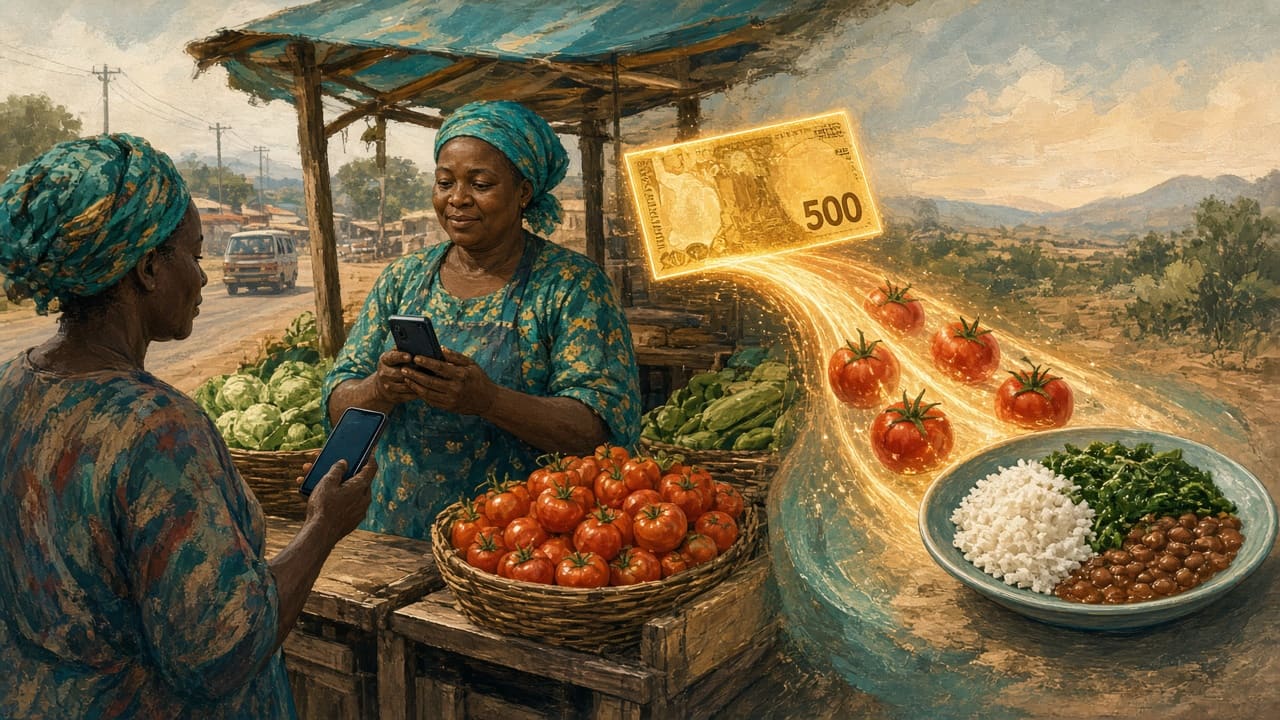
What happens next matters. If charges eat too much of the five hundred, the seller restocks less. If the money arrives late, she cannot buy from the farmer at dawn. If a wrong payment cannot be reversed, trust breaks between neighbours who must keep trading. Rules that look technical on a drafting table decide whether that stall stays open.
Shared well-being, in this reading of Ubuntu, asks whether payment providers can prosper while helping their customers thrive, not by extracting from people who have the least room to wait.
Payments That Work Across Providers
Editorial illustration of interoperability. Teal and amber light ribbons from two phones meet at one vegetable basket. No brand logos. Conceptual art.

Different payment services working together, often called interoperability, means a customer on one network can pay a trader on another without awkward workarounds. The draft Bill proposes duties for providers to use systems that can work with others. The draft policy also aims for stronger connections across the payment ecosystem.
What might that mean for a trader? Fewer apps to juggle. Lower costs when money does not bounce between closed walls. An easier choice to switch providers if service is poor. Those outcomes are not automatic. They depend on how the rules are written, priced and enforced.
This article recommends watching three tests: fewer tools on the counter, fairer charges, and real freedom to leave a bad service without losing customers.
A Person’s Financial Story
Editorial illustration of open finance and consent. A Kenyan trader holds a key over a handwritten ledger; soft data paths wait outside a gate. Conceptual metaphor, not a bank product.
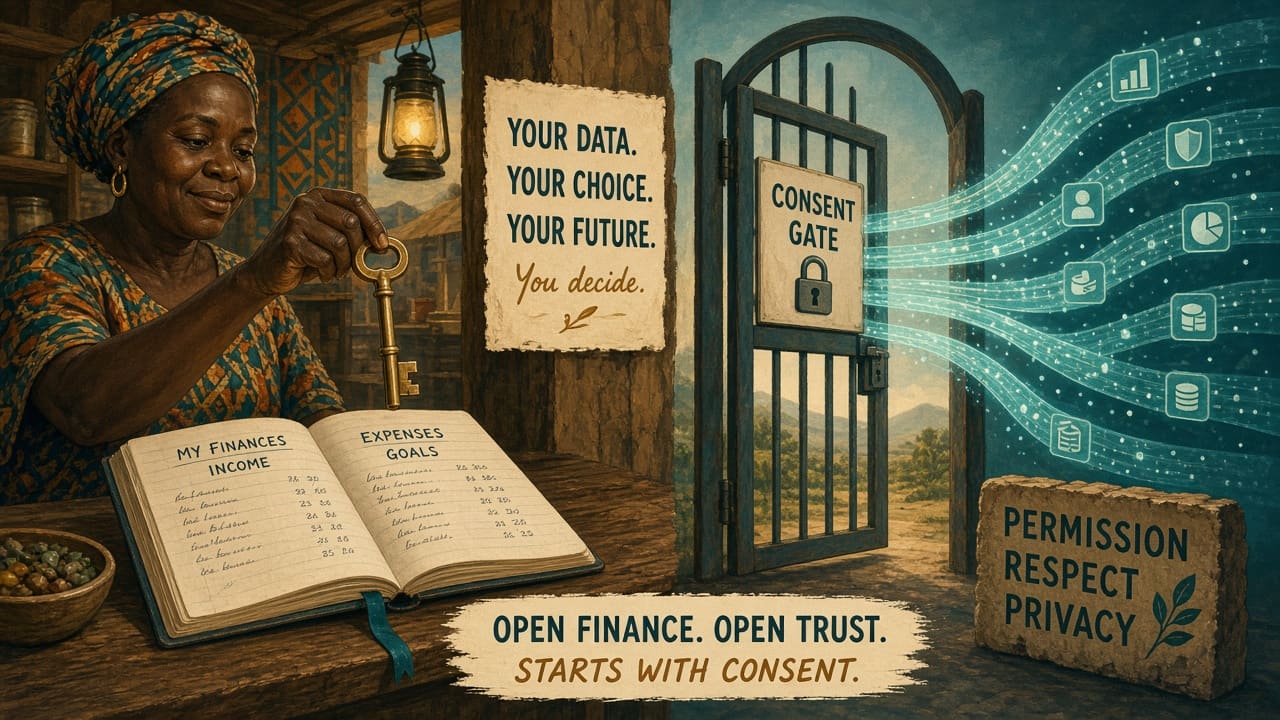
Open finance, in the draft materials, is about sharing financial information securely with a customer’s permission so new services can be built. Matching payments to sales, for example, can help a small business keep clearer records. That can be useful.
Permission is the hinge. The Bill’s open-finance clause ties secure sharing to customer consent and leaves detail to later regulations. Sharing data does not guarantee a loan. It also must not quietly strip people of control over their own financial story.
Personal agency, on this Ubuntu-inspired reading, means community benefit should coexist with each person’s privacy and freedom to choose, consent that people can understand, refuse and withdraw without losing basic access to pay and be paid.
A Fair Chance for New Businesses
Editorial illustration of three gateways: a small wooden door, a medium iron gate, and a heavy vault-like door on a Kenyan market street. Metaphor for risk-matched capital requirements. No readable figures on the gates.

The draft Bill’s Third Schedule sets proposed minimum capital amounts for different licences. Selected examples: KES 5 million for account-information services, KES 10 million for payment gateways, and KES 250 million for electronic money issuers. These are proposed core-capital requirements, not application fees, and they are not yet law.
Customer protection matters. Holding other people’s money is serious. Entry requirements should match the risks of each activity. A firm that only helps customers view account information is not the same as one that issues electronic money at scale. If the bar is set without that distinction in practice, innovation for traders and chama groups may shrink even where risk is low.
Reciprocity asks what responsibilities accompany the benefit of serving a community: enough capital and conduct rules to protect customers, without closing the gate to careful new entrants who could lower costs and widen choice.
When Something Goes Wrong
Editorial illustration of complaint dignity. A Kenyan trader shows a missing payment on a phone at a help desk; a clock ticks; a hearing window is half open. Conceptual art, no corporate logos.

A missing payment is not a footnote. It is stock that never arrived and a household that waits. The draft Bill’s market-conduct clause would require clear information on fees and terms, accessible complaint handling, and protection of customer data. Separately, trust arrangements would require certain customer funds to be held safely, ring-fenced from a provider’s own business money.
Human dignity shows itself here: does someone with a small complaint receive a fair hearing, in language they understand, within a time they can survive? This article recommends that public comments press for plain timelines, reachable help desks and clear routes to challenge an unfair decision, not only fine words about confidence in the system.
Fair Management of Shared Infrastructure
Editorial illustration of shared payment infrastructure. A glowing shared highway runs through a Kenyan market; handcarts and vans share the road with soft toll markers. Conceptual metaphor for an instant payment switch.
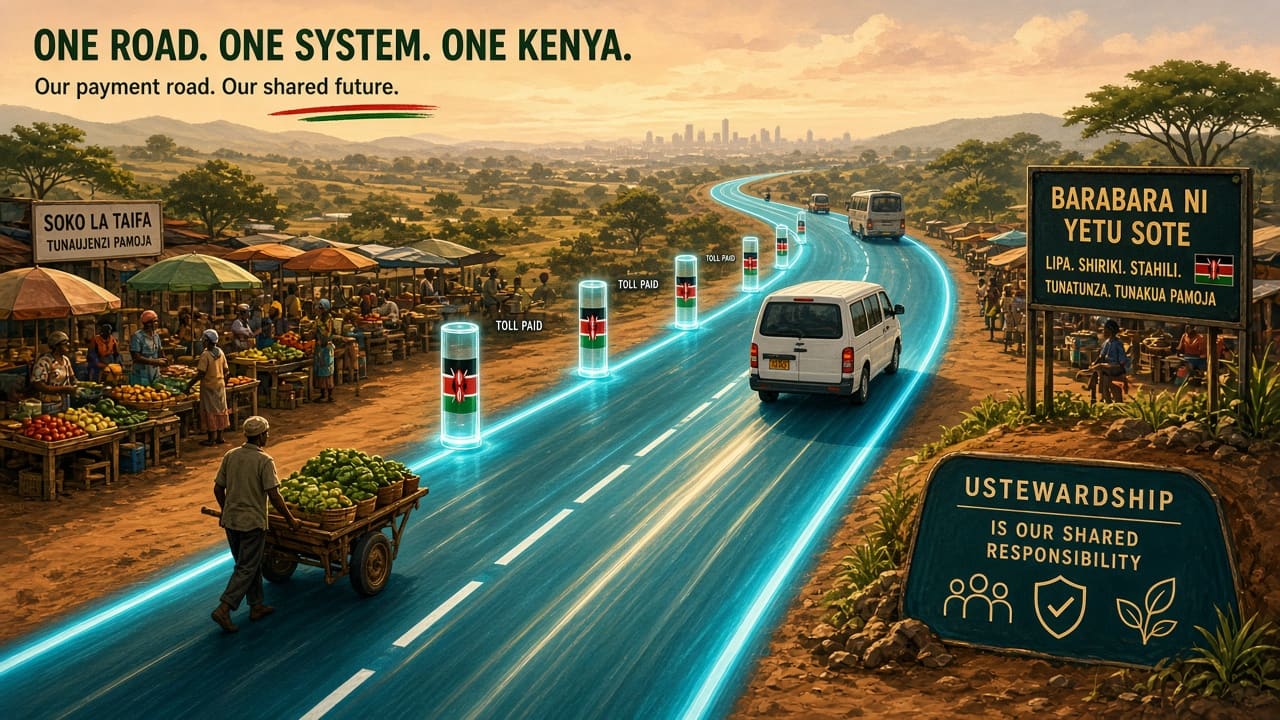
The draft policy proposes developing and implementing a national instant payment switch, a shared road meant to move retail payments quickly between participants. Think of it as common infrastructure, not a private driveway owned by whoever arrived first.
Stewardship, in this essay’s sense, asks how those who manage shared payment infrastructure exercise their power. Transparent charges, fair access for smaller participants, reliable service and a real voice for those who serve traders at the edge of the market are practical tests. Without them, a national switch can become another gate dressed as a road.
A Public Discussion Ordinary People Can Join
Public comments on the drafts were invited by Friday, 9 October 2026, using the official templates and emailed to paymentslawreview@centralbank.go.ke, with regional forums also listed in the notice. Traders, chama members, customers and developers all have specific experiences worth putting on paper: delayed settlements, confusing fees, blocked refunds, tools that refuse to talk to one another.
This is not only a conversation for lawyers. It is a conversation about who gets a fair chance to make a living when money must pass through a gate.
Ubuntu gives us a demanding question to carry into this discussion: how will these rules help people thrive together?
Real business is in policy. When we write the rules of the marketplace, we help decide who gets a fair chance to make a living.
Series introduction
Real Business Is in Policy
Part I, including Kenya’s mobile-money rules under the existing payment law.
Series companion
Who Owns the Gate to Opportunity?
Part V, how institutional gates shape who may advance after entry.
Series companion
What Kenya’s Post-Vision 2030 Blueprint Could Mean for Enterprise
Part II, when national plans meet the firms that must deliver them.
Sources and Further Reading
Sources checked: 29 September 2026. Consultation drafts and notice only, not enacted amendments.
- Central Bank of Kenya: Draft National Payment System Policy and National Payment System Bill, 2026 (announcement and consultation links)
- Draft National Payment System Policy, 2026 (CBK PDF)
- National Payment System Bill, 2026 (CBK PDF), including market conduct (cl. 27), interoperability (cl. 28), open finance (cl. 29), trust arrangements (cl. 36-39), repeal (cl. 78) and Third Schedule capital minima
- Public Notice: Draft National Payment System Policy and National Payment System Bill, 2026 (comments by Friday, 9 October 2026; paymentslawreview@centralbank.go.ke)
- Template for comments on the Draft National Payment System Policy, 2026
- Template for comments on the National Payment System Bill, 2026
- Desmond & Leah Tutu Legacy Foundation: “The People’s Arch” (Ubuntu and relational humanity; background for this article’s interpretive lens)
- Real Business Is in Policy (Part I): ThePortal
- Real Business Is in Policy (Part V): Who Owns the Gate to Opportunity?: ThePortal
From reading to civic action
Payment rules shape who can trade and how safely money moves. Follow illustrative market challenges and accountability commitments that keep delivery visible.
Improve this article
Ask a question, suggest a correction, submit a source, share experience, or propose a topic. Contact details stay private. Publicly consequential allegations need editorial review.