Real Business Is in Policy (Part III): Coffee, Cash Crops and the Chief
When Policy Built the Market Before the Entrepreneur Arrived
On this page
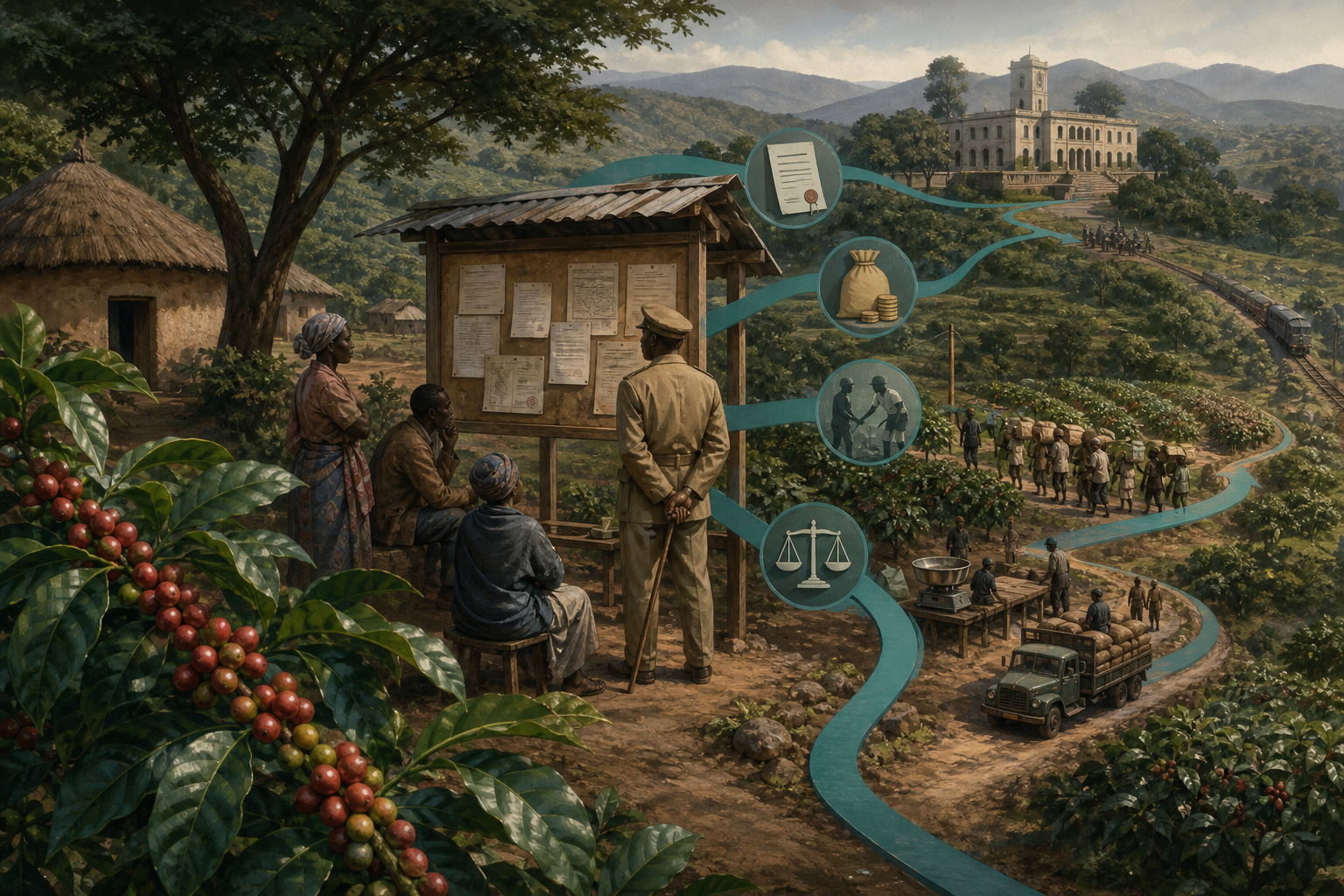
Editorial illustration. Coffee trees with ripe cherries stand in a Kenyan highland shamba. Teal ribbons connect the trees to a village notice board and administrative path, then onward to licences, labour routes and market channels. The scene suggests that the coffee economy was designed by rules and institutions, not merely discovered by entrepreneurs.
From Part I: Markets Are Cultivated Spaces
In Part I of Real Business Is in Policy, I argued that markets are cultivated spaces. Laws, licences, standards, public institutions, infrastructure and incentives help determine who may participate, how value moves and who carries the risk.
Part II applied that thesis to Kenya’s conversation beyond Vision 2030, asking how national blueprints become enterprises, jobs and public value. This Part III looks backward, because the argument is not new to Kenya.
Long before digital payments, eTIMS, data-protection rules, procurement platforms or innovation policy, colonial Kenya had already demonstrated, in a much harsher form, how profoundly public policy can manufacture an economy.
Consider coffee.
We remember coffee as a cash crop.
But before asking how much cash coffee produced, there is a more revealing question:
Who was allowed to grow it, who was required to work around it, who controlled its route to market, and who ultimately captured the cash?
That question takes us from the coffee tree to the architecture surrounding it: land policy, taxation, labour, licensing, agricultural regulation, settler interests and the colonial administrative system.
And standing remarkably close to the citizen throughout that architecture was one institution: the Chief.
When the colonial state entered the shamba, it did not only inspect soil and rainfall. It entered with rules about who could plant, who must work, who owed tax, and who spoke for government at the village gate.
Coffee as a Policy Laboratory
The connection matters because it reveals the other side of the proposition that real business is in policy.
Good policy can create markets.
But policy can also create market power.
It can determine who enters.
It can determine who remains outside.
It can make one person an entrepreneur and another person’s labour an input into that entrepreneur’s business.
It can turn fertile land into an asset for one group and a labour reserve for another.
And, eventually, it can open the same market it previously restricted.
Coffee therefore gives us something more valuable than a history lesson. It gives us a policy laboratory.
The lesson is uncomfortable but important:
Markets do not merely allocate value. The rules governing markets often determine who gets the opportunity to create and capture that value in the first place.
Part I identified Permission, Obligation, Incentive, Procurement and Infrastructure as ways policy creates commercial demand. This Part III puts colonial coffee through those lenses, adapting Procurement into the institutional machinery that transmitted rules, and adds a sixth that Part I only partially captured: Power.
Editorial conceptual diagram. A coffee tree sits at the centre. Six labelled lenses surround it: Permission, Obligation, Incentive, Infrastructure, Institutions, and Power. Power is visually emphasised as the deepest business question: who wrote the rules that made the market possible, and whose interests those rules originally served.
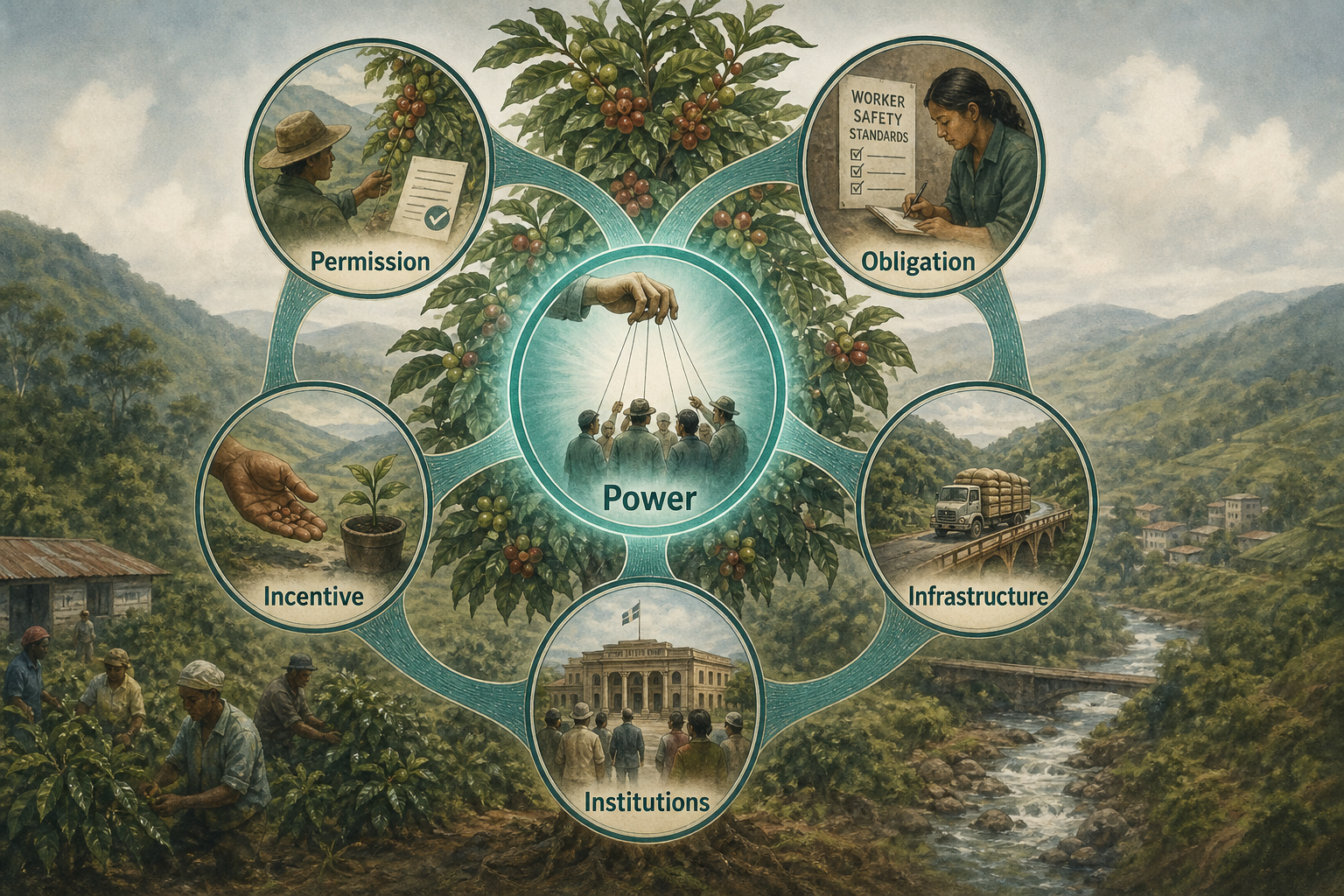
So the Part III analytical model becomes:
- Permission: Who was permitted to grow coffee?
- Obligation: What taxes, labour requirements and administrative duties shaped behaviour?
- Incentive: Who benefited economically from production?
- Infrastructure: Who controlled processing, transport and market access?
- Institutions: How did chiefs, cooperatives and agricultural administration transmit the rules?
- Power: Who could change the rules, and who merely lived under them?
The deepest business question is not merely, “Where is the market?” It is, “Who wrote the rules that made this market possible, and whose interests did those rules originally serve?”
Permission: Who Was Allowed to Grow Coffee?
In Kenya, coffee was never merely a crop planted in fertile soil. It was planted inside a political and administrative system, a system that determined who could own productive land, who could grow valuable crops, who supplied labour, who accessed licences and markets, and who represented government at village level.
Coffee was the export. The chief was the interface.
A necessary historical correction is required here.
It would be inaccurate to say that the Chiefs’ Act was enacted specifically to force Africans to grow coffee. For much of the colonial period, Africans were not being compelled to grow coffee for themselves. On the contrary, African cultivation of high-value Arabica coffee was restricted because European settlers wanted to preserve coffee as a settler-controlled enterprise and retain African communities as a source of labour.
Experiments allowing Africans to grow coffee occurred in places such as Gusiiland during the 1930s, but government policy curtailed further expansion by 1938. Broad African household participation in commercial coffee growing only became significant during the 1950s.
Permission, in other words, was not a neutral licence. It was a gate. For decades the gate stayed closed to African growers of the most valuable coffee, and open to settler estates that needed African labour.
When the gate later opened, it did so selectively. Politically acceptable, landholding or officially recognised farmers gained access first. Mass smallholder production followed. The crop that had once symbolised settler privilege later became an instrument of African advancement, but it entered African hands through institutions already shaped by colonial licensing, gatekeeping and administrative control.
Obligation: Taxes, Labour and the Chiefs’ Act
The official statute is the Chiefs’ Act, Cap. 128, which commenced on 24 March 1937. Its purpose was to define the duties and powers of chiefs as local representatives of government. It formed part of a wider colonial administrative structure through which government orders could be communicated, enforced and monitored at community level.
The more accurate historical relationship is therefore this: the chief did not initially force the African farmer to grow coffee. The colonial system used chiefs, taxes, land controls and administrative orders to make African labour available to the settler coffee economy.
Colonial rule could not place a European administrator in every village. It therefore governed through chiefs, headmen, native tribunals, local councils and administrative orders. Under that arrangement, the chief could become responsible for maintaining public order; summoning people for official purposes; communicating government directives; mobilising labour and community work; collecting or supporting the collection of taxes; reporting resistance or noncompliance; and supervising land use, grazing, tree planting and environmental orders.
Contemporary legal analysis has described the old chief-based administrative framework as oriented toward sanction and compulsion rather than consultation. Various provisions allowed chiefs to issue or enforce orders relating to activities such as tree planting, cutting, grazing and fire control.
The chief therefore represented more than traditional leadership. Within the colonial system, the office became an administrative technology: the point at which distant government policy entered the household, the village and the shamba.
This does not mean every chief acted identically. Some abused their authority; some accumulated land and privilege; some attempted to negotiate between their communities and colonial officers; and others quietly protected their people. Nevertheless, the institutional design generally made chiefs accountable upward to the administration, rather than downward to the community.
Coffee estates required substantial quantities of labour, particularly during harvesting. Colonial records and parliamentary debates show officials wrestling with the difficulty of securing enough African workers for settler agriculture.
Taxation was part of this labour architecture. Hut and poll taxes created monetary obligations in communities whose economies were not fully monetised. To obtain cash for taxes, many African men had to leave their land temporarily and seek paid employment on settler farms, in towns, on railways or in public works.
British parliamentary debates on Kenya openly discussed taxation as a means of pushing Africans out of the reserves and into wage labour. The same debates recorded the enormous labour requirements of the coffee harvest and the use of native-authority mechanisms during labour shortages.
Editorial process diagram with five stations on a teal pathway: 1. Tax obligation, hut and poll tax papers. 2. Need for money, cash required in a partly non-monetised economy. 3. Wage labour migration, people leaving reserves for paid work. 4. Settler coffee harvest, labour on estates during picking season. 5. Export profit, coffee sacked and shipped for foreign exchange.
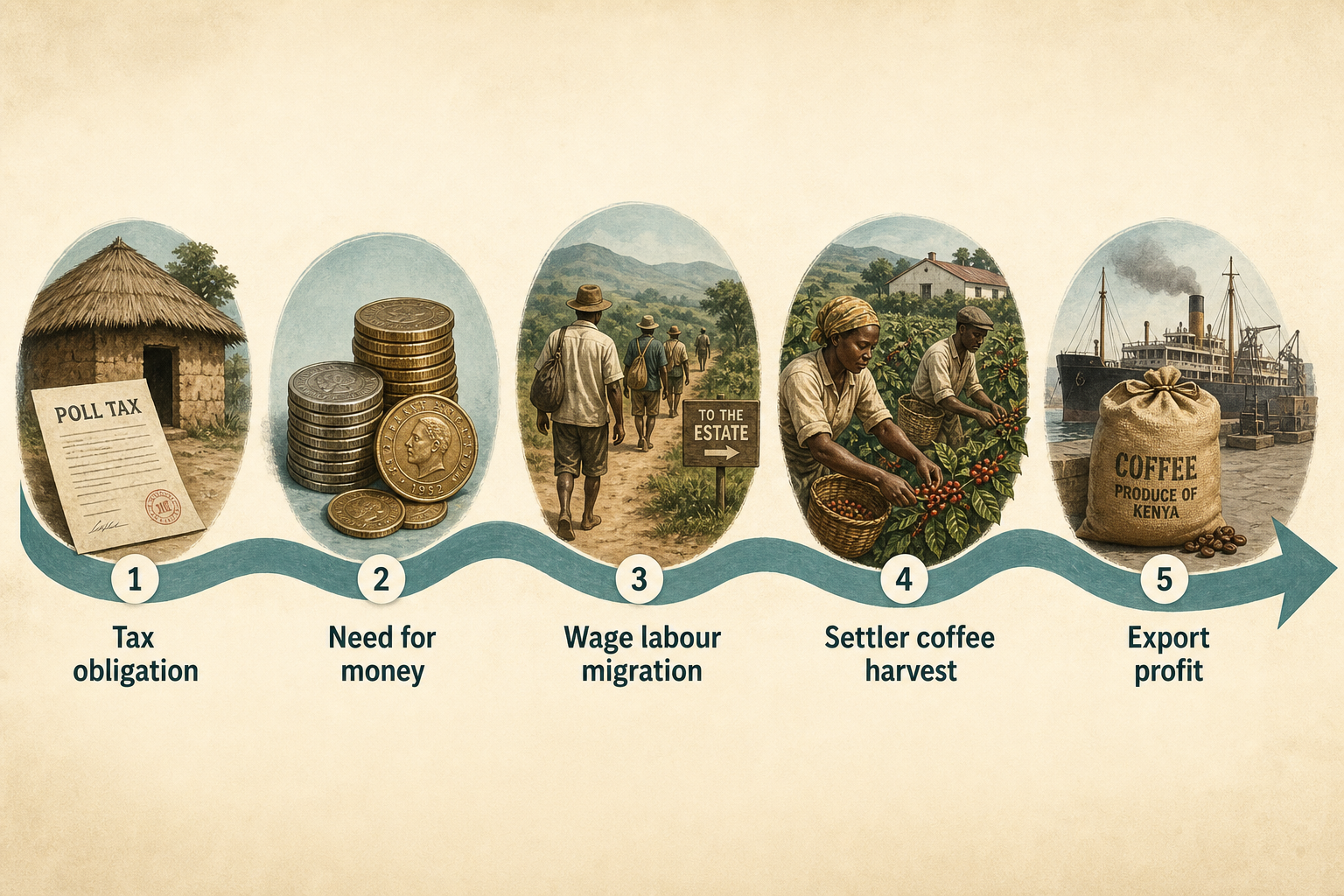
The relationship can be represented as a chain: tax obligation → need for money → migration for wage labour → settler access to workers → profitable export agriculture.
The chief stood at several points in this chain: identifying taxpayers, communicating orders, mobilising labour, reporting absentees and enforcing local administrative requirements. Coffee’s profitability was therefore not simply the outcome of climate, entrepreneurship or international demand. It was supported by a political system that influenced the price, availability and movement of African labour.
Incentive: Cash for Whom?
“Cash crop” sounds economically neutral. It merely appears to describe a crop grown for sale rather than household consumption.
But the deeper question is: cash for whom?
A crop may generate foreign exchange for the state while leaving the grower poor. It may create profit for exporters, millers, marketers, financiers and international roasters while transferring production risk to the farmer.
The farmer carries the cost of land, seedlings, fertiliser, labour, disease, climate and delayed payment. Yet the farmer may have the least influence over grading, milling, auctioning, contracting, deductions and the final consumer price.
The term “cash crop” can therefore conceal an unequal political economy.
Coffee becomes genuinely empowering only when the grower has meaningful control over the decision to plant; production information; cooperative governance; processing and grading data; market access; payment timing; price transparency; ownership of brands and intellectual property; and participation in the value added after the bean leaves the farm.
A farmer who owns the tree but not the information, price, brand or route to market possesses only the biological asset. Others may still own the economy surrounding it.
In the settler era, incentives were starkly asymmetric: settler estates captured the commercial upside of coffee while African communities were structured as labour supply. Later, when African smallholders entered production, incentive problems did not disappear; they migrated into cooperatives, marketing boards, milling, grading and payment systems.
Infrastructure: Who Controlled the Route to Market?
Markets are not only permissions and obligations. They are pipes: mills, graders, transporters, auction floors, exporters and today digital platforms and payment rails.
Whoever controls processing, grading and market access controls much of what “cash” means after harvest. Infrastructure can look technical while functioning as political economy. A farmer may plant and tend; another institution may decide quality class, timing of sale and how much of the final price returns to the shamba.
That is why Part I insisted that infrastructure is a demand-creation and value-shaping mechanism. In coffee, infrastructure decides whether the grower’s bean becomes an enterprise asset or merely an input into someone else’s balance sheet.
The colonial and post-colonial coffee economy repeatedly showed the same pattern: control of the route to market could matter as much as control of the tree. When farmers lack transparent grading data, timely payment and real influence over offtake, the “infrastructure” of the value chain becomes another form of gatekeeping, quiet, procedural and decisive.
Institutions: The Chief, the Cooperative and the Habit of Mobilisation
Independence changed the political leadership of the state, but it did not immediately replace every colonial administrative instrument.
The Chiefs’ Act remained in Kenya’s statute book. A number of its more coercive provisions were repealed or substantially amended in 1997, and later legal reforms further constrained the exercise of administrative power. The statute nevertheless survives in amended form.
The deeper inheritance is not simply the existence of the Act. It is an administrative habit:
government announces; chiefs mobilise; citizens comply; intermediaries administer; producers wait to be paid.
That habit can survive even where explicit legal compulsion has disappeared.
It appears whenever development is measured by the number of seedlings distributed rather than the profitability of farmers; whenever farmers are instructed to increase production without being shown the market; whenever cooperative officials know more about coffee sales than the members who own the coffee; or whenever increased exports are celebrated while producers remain indebted.
Institutions transmit the rules. Chiefs, cooperatives, boards and marketing systems can either make the farmer the economic principal, or keep the farmer as the last person to learn what the coffee actually sold for.
Power: Who Could Change the Rules?
During the 1950s, colonial policy began to change. Africans were gradually permitted to grow coffee and other lucrative cash crops, particularly under the agricultural restructuring associated with the Swynnerton era.
But this opening was not simply an act of economic liberation. It was also political.
The colonial government sought to create a class of commercially successful African farmers who had property, income and a material interest in political stability. Research on Kenya’s coffee economy describes the selective opening of Arabica production to African farmers partly as a counter-insurgency strategy. Studies of coffee-growing areas also show how commercial agriculture contributed to the formation of a landed, increasingly differentiated African rural class.
Coffee cultivation thus shifted through three broad phases:
- Exclusion: African communities supplied land and labour but were largely excluded from the most valuable crop.
- Selective permission: politically acceptable, landholding or officially recognised farmers gained access to coffee.
- Mass smallholder production: coffee became a major source of household income, cooperative participation, school fees and rural investment.
From exclusion to controlled inclusion, coffee’s history shows that market access can be redesigned without relinquishing the power to redesign it. Power is the lens that explains those transitions. Permission, obligation, incentive, infrastructure and institutions all matter, but someone wrote and rewrote them. The settler state could close the market. The late-colonial state could open it selectively. A developmental republic must ask who holds that pen now.
The Contemporary Governance Lesson
Kenya entered a new coffee regulatory environment under the Coffee Act, 2026, which came into effect in March 2026. The historical lesson is therefore highly relevant: regulatory reform must protect farmers from value-chain capture rather than merely recreate control under new institutions.
A democratic coffee economy should replace:
- compulsion with informed choice;
- mobilisation with enterprise support;
- production targets with farmer profitability;
- administrative secrecy with traceable evidence;
- cooperative gatekeeping with member-controlled governance;
- raw-bean dependency with local roasting, branding and market ownership.
The contemporary chief can still play a valuable role, but as a convenor rather than a commander: connecting farmers with extension services, climate information, disease surveillance, financing, conflict resolution and public programmes.
The farmer must remain the economic principal.
The Central Proposition
The historical problem was not coffee itself. Coffee financed education, homes, businesses and social mobility for many Kenyan families. The problem was the governance structure surrounding the crop.
Colonial administration asked: how many trees can the subject be made to plant, tend or harvest?
A developmental state must ask: how much value can the citizen who grows the tree own?
Coffee will cease being a colonial inheritance when the farmer owns not only the tree, but also the evidence, the decision, the market relationship and a fair share of the final value.
A crop becomes a cash crop only when the grower controls the cash.
That is where this series returns to its opening claim. Real business is in policy, not because entrepreneurs should capture the state, but because rules decide who may build, who must labour, and who may keep what they create. Part I named the mechanisms. Part II asked how Kenya’s next blueprint becomes enterprise. Part III reminds us that those mechanisms have always had owners.
Continue to Part IV
The School Gate and the Debt Ledger
Series: Real Business Is in Policy, how education funding rules shape access, repayment and risk.
Read Part I
Real Business Is in Policy
Series: Real Business Is in Policy, how rules, institutions and lived practice cultivate markets.
Read Part II
What Kenya’s Post-Vision 2030 Blueprint Could Mean for Enterprise
Series: Real Business Is in Policy, apply the thesis to Kenya’s conversation beyond Vision 2030.
Sources and further reading
From reading to civic action
Cash-crop rules and local authority still shape who captures value. Document a shared market or land-system challenge, then follow commitments to delivery.
Improve this article
Ask a question, suggest a correction, submit a source, share experience, or propose a topic. Contact details stay private. Publicly consequential allegations need editorial review.